Knee

Knee Osteoarthritis - Part 1 Your Options

Osteoarthritis (OA) is the most prevalent joint disease and a leading source of chronic pain and disability worldwide.

There is a common perception among people with knee arthritis that nothing can really be done, (outside of taking medications or having knee replacement surgery).

This study by Mitchell and Hurley (2008) showed that many people were unaware of the options available to them, despite consulting with their general practitioner.

Research indicates less than 4% of people attending a GP clinic with knee osteoarhritis are referred to a Physiotherapist.

The intention behind this blog post is to inform you of some of your options, so you can make an educated decision about what is best for your situation.


Knee OA…what options do you have?

1. Ignore the pain

This can be an effective strategy in the beginning. Ignoring the pain and getting on with things can be actually be quite helpful.

This usually works particularly well when you are young and resilient.

Our bodies are masters at compensating and this means you can still do what you want in the short-term as your body may be able to transfer load from the knee into the hip or lower back.

As you get older though (around the age of 30+), this strategy has less effect as the compensatory patterns have a limited capacity.

As your body runs out of options and strategies, you will eventually find yourself not recovering like you did before and the stiffness and pain starts to get stronger.

2. Rest the knee and avoid using it

Advice to rest and avoid pain is commonly provided to people with knee and other joint pains - advice that is often wrong, and harmful.

Unfortunately the majority of people with knee OA reduce moving due to fear they will wear the knees out and make things worse.

This leads to a downward spiral of pain, weakness and a loss of confidence.

Interestingly, we know that weak thigh muscles are one of the biggest risk factors for ongoing knee pain. When you stop moving and become inactive, muscle loss accelerates significantly.

dHPLn.jpg

Sarcopenia

At some point in your 30's you naturally start to lose muscle mass and function.

Physically inactive people lose an average 3-5% of their muscle loss per decade after the age 30. The technical name for this is sarcopenia.

The picture above demonstrates the dramatic consequences of an inactive lifestyle and severe muscle wasting.

Adipose tissue refers to the fat layer around the muscles.

Clearly, avoiding movement is not going to be your best solution.

What about running, won’t that lead to increased OA?

Interestingly, recreational runners (3.5% risk) had a lower occurrence of developing knee OA compared with non-runners (10.2%).

One of the main ways running protects you from arthritis is by maintaining you at a healthy weight. This leads us to our next point.

3. Weight Loss

Obesity is a strong risk factor for knee pain and increases the risk of symptomatic knee osteoarthritis.

Women who are overweight are four times more likely to develop knee OA than women who are a healthy weight. And men who are overweight are five times more likely to develop OA than men who are a healthy weight.

Scales.jpg

But losing even a small amount of weight can be beneficial. For people who are overweight, every 5 kg of weight loss can reduce the risk of knee OA by more than 50 percent.

4. Medication

Medications such as panadol and anti-inflammatories have their place when you have an acute flare-up of knee pain.

But they are not designed for long-term use, due to their side effects on the liver and gastro-intestinal system.

5. Arthroscopic Surgery

Traditionally, arthroscopic surgery has been performed for chronic knee pain. Over the past few years however the research has indicated that for people with degenerative knee pain (including meniscal lesions), performing arthroscopic surgery does not improve outcomes.

The evidence refuting arthroscopy to treat meniscal degeneration and knee osteoarthritis (OA) is now clear and compelling. In Australia, the number of arthroscopies for degenerative knee pain has halved since 2011.

If the knee pain and degeneration is severe, conservative measures have been tried and you are having difficulty functioning day to day, then a Total Knee Replacement would be a logical thing to consider in consultation with your doctor.

However, the point being made here is that arthroscopic surgery is not required for degenerative knees.

Of course with any surgery there is the risk of infection and blood clots forming in the leg, as well as post-op recovery and rehabilitation for a few months afterwards.

6. Exercise therapy: the treatment of choice for Knee OA

Exercise therapy has the best evidence providing both short and long term benefits to people with knee OA.

High-quality evidence suggest that land-based therapeutic exercise provides benefits in terms of reduced knee pain and improved quality of life (Bennell et al 2015). This benefit can be sustained for 2-6 months after cessation of formal treatment.

Exercise therapy involves a combination of supervised sessions with a health professional to target:

  • strength

  • cardiovascular fitness

  • flexibility

  • neuro-muscular retraining

Getting all the pieces of the puzzle to get you back to doing what you love.

Getting all the pieces of the puzzle to get you back to doing what you love.

As you begin an exercise program, you may need to allow a period of 'body tuning' i.e. using manual therapy, taping, massage and dry needling to improve tissue quality and joint alignment.

Similar to playing an instrument, tuning up before hand makes things perform much better and reduces pain and tightness.

This is where are a good Physio comes in, who has a deep understanding of knee pain and a passion for helping people overcome it.

We do that everyday of the week and you can find out more about us here.

Summary

We know that movement and exercise can be what truly helps knee pain.

The evidence is compelling.

It addresses all of the modifiable factors that can get you out of reactive mode, and into building your foundation.

But what type of exercise specifically helps?

READ PART 2 OF THE BLOG —> CLICK HERE

If you have any questions in the meantime, please feel free to contact us.

If you'd like to see how we can help set you up with a plan of attack to overcome your knee pain, please use our easy online booking system to schedule an initial appointment.


References:

Mitchell HL, Hurley MV. Management of chronic knee pain: a survey of patient preferences and treatment received. BMC Musculoskelet Disord. 2008 Sep 18;9:123


Exercise for osteoarthritis of the knee: a Cochrane systematic review.

Fransen M, McConnell S, Harmer AR, Van der Esch M, Simic M, Bennell KL.

Br J Sports Med. 2015 Dec;49(24):1554-7

The Association of Recreational and Competitive Running With Hip and Knee Osteoarthritis: A Systematic Review and Meta-analysis.

Alentorn-Geli E, Samuelsson K, Musahl V, Green CL, Bhandari M, Karlsson J.

J Orthop Sports Phys Ther. 2017 Jun;47(6):373-390.
"Surgery versus Physical Therapy for a Meniscal Tear and Osteoarthritis, The New England Journal of Medicine, 2013"

An Exercise For Tight Hip Flexors That Works Better Than Stretching

It's 'Global Running Day'... One of my fav exercises for runners, especially those with issues with their hips.

This drill will build capacity in the hip flexors (TFL, rectus femoris and iliopsoas), an important group of muscles for running. 

Like the hamstrings, the hip flexors often end up in constant 'protective mode' due to weakness and lack of strength.  Sitting all day tends to make them tight as hell.

This exercise will help get to the root cause of your tight hip flexors and also help to switch on your glutes.

Stand with theraloop around the middle part of your feet.
Drive one knee up so your thigh is parallel to the ground while also activating your core.


Important ➡️The weight bearing leg drives down⬇️ to the ground, strongly activating the gluteals. ✅This will help improve your running efficiency and gluteal activation on push off.


Happy Running!


#globalrunningday #runnersbody #runnersworld #runnersofinstagram #running #runningcommunity #resilientrunner #runforlife #runningtherapy #runninginspiration

Top 10 Muscles That Respond To Dry Needling

Top 10 Muscles That Respond To Dry Needling

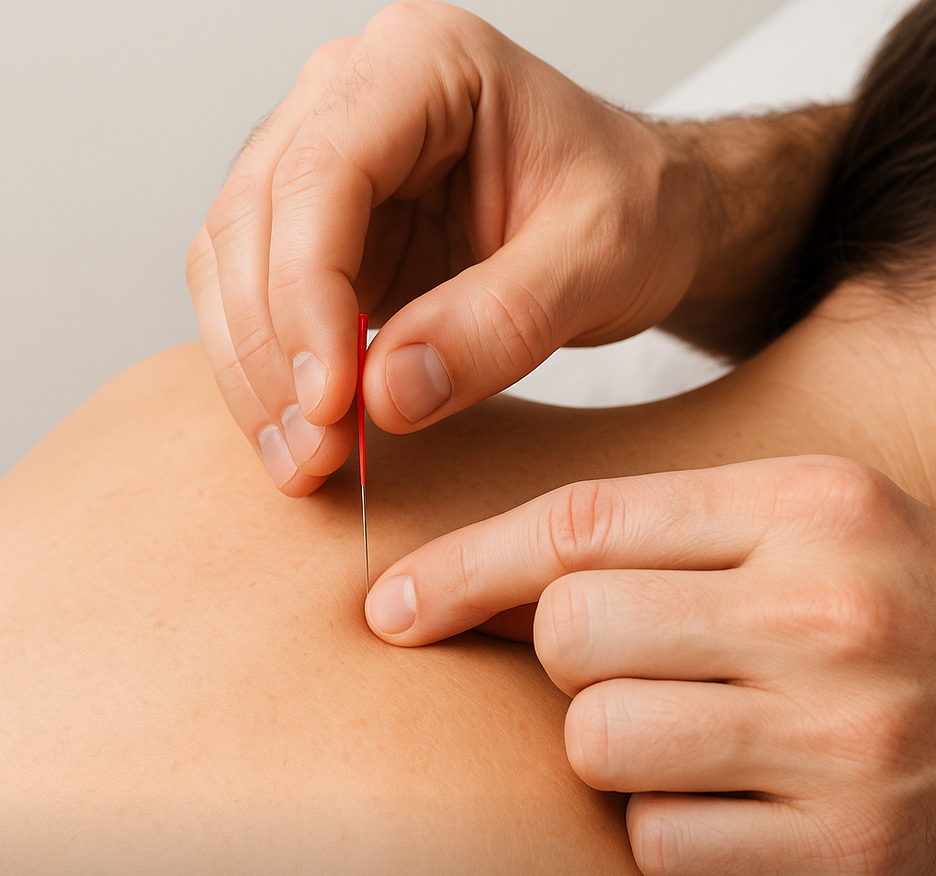
One of the benefits of dry needling is it's a very precise way of releasing a muscle. 

Compared to massage, getting a twitch response out of a muscle gives a very predictable and effective release, deep from within the muscle belly.

In this post, I wanted to give you some insight into some of the best responding muscles that dry needling can help with.

If you want to learn more about exactly how dry needling works, please read more here.

Of course dry needling can be done to any muscle.   The following post is to give you some insight into some commonly treated muscles that give especially good 'bang for your buck'.

*Please also see some important notes at the end of the post.

1.  Deltoids

deltoid-all-tps.gif

In terms of shoulder pain, the deltoid is a very under-rated muscle.

The deltoids include three sections (anterior, middle and posterior) that sit superficially around the shoulder.  The deltoid is involved in almost all shoulder movement.

The way the it wraps around the shoulder makes it a very difficult muscle to stretch and it is prone to building up tension.

Trigger points and knots often develop in the deltoid that can give rise to shoulder pain (see pic above). 

This pain can be quite severe and unrelenting and stubborn to usual treatment.

A common history is over-doing some push-ups and waking up the next day with pain in the front of the shoulder. 

Or someone who has done a lot of heavy over-head weights (Cross fitters...!) over the years and doesn't do much stretching. 

Sometimes it's the last small movement and final straw the breaks the camels back so to speak.

Dry needling the deltoid often gets some powerful twitch responses. 

Expect soreness and a dead arm feeling for a few days before things settle down.

2. Latissimus Dorsi

latissimus-dorsi-trp.jpg
Latissimus_dorsi.PNG

The latissimus dorsi is a fascinating muscle. 

It has attachments to the hip, shoulder, upper back, lower back and rib cage - and that makes it the largest muscle in the upper body.

Tightness in the latissimus dorsi has been shown to be an important cause of chronic shoulder pain and chronic back (especially upper back) pain.

Because of its extensive attachments, it can be another difficult muscle to stretch effectively. 

Dry needling gets in there and gets the job done.

If your lats are tight, you will need to add in some regular childs pose and over-head stretching, in addition to foam rolling your upper back.

3. TFL / ITB

438.jpg

The fastest way to release your ITB

Release the under-rated small muscle that attaches to it, called the Tensor Fascia Latae (TFL).

The TFL is a small but powerful hip flexor and usually tight from excessively sitting, walking, running and cycling.

When overly tight, can contribute to knee pain by causing mis-tracking of the kneecap. 

Combine dry needling with some specific gluteal activation and you will be well and truly on the way to saying goodbye to your ITB pain and tightness. 

If you look after your TFL well, there's a good chance that excruiating ITB foam rolling will not be required.  Happy days :-)

4. Glutes

Gluteus Medius_0.jpg

One of the cool things about dry needling is that we can access deep points in a muscle that you would otherwise be unable to access.  

The gluteus medius is an interesting muscle that can be dysfunctional in chronic lower back pain, hip pain and knee pain.  

Dry needling can immediately 're-set' the glutes and allow for a graduated re-loading program. 

Long-term, a well functioning gluteus medius will protect your hips, knees, ankles and lower back. 

5. Calf - Gastrocnemius & Soleus

Gastrocnemius.jpg

Calf muscle tension and limited flexibility is especially common in the modern age. 

When tight, the calf muscles are prone to cramping and eventually tearing.

Deep tissue massage can be effective, but can be very painful, bordering on intolerable.

Dry needling to the calf muscles, whilst intense, is quicker and more effective in its release. 

Expect some treatment soreness for 1-2 days post-needling.

And don't forget to re-build your calf capacity with an appropriate strengthening program.

6. Upper Trapezius

78b36a394ffbec76dc123158ae7dcda7.jpg

Much like the calf above, the upper traps can be loaded with tightness. 

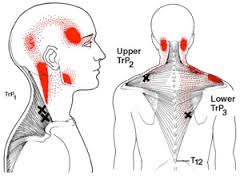
Causes can include poor posture, lack of physical activity and prolonged stress. 

Heavy handed massage can stir up more irritation in the muscle.

Dry needling is more like using a sniper approach - with a few direct releases, you can release the traps and get the blood flowing much more effectively and deeply. 

This study recommended dry needling for immediate pain reduction in upper body myofascial trigger point dysfunction.

Using heat on the traps via a wheat pack is really helpful, especially in the evening before bed.

Also make sure you are getting enough down time as chronic upper traps tension is a sign of sympathetic over-activity.

7. Infraspinatus

Infraspinatous-TrPs.jpg

The infraspinatus is a sneaky little muscle that sits behind your shoulder blade. 

It is often weak and gets overloaded when using your arm and shoulder.  

When the infraspinatus gets tight, you'll often feel pain in the front and deep part of your shoulder.

Dry needling de-activates the trigger points quickly, but be prepared for a dead arm for a few hours.

Don't forget to re-build with some simple strengthening exercises with a thera-band.


8. Wrist Extensors

extensor-digitorum-ring-finger-trp.jpg

Tennis elbow is a very common condition that primarily affects the extensor tendons on the outside of the forearm. 

The pain often drags on for months and years due to a very poor blood supply in the elbow tendons.

The research shows that dry needling releases a very specific chemical, known as Platelet-Derived Growth Factor (PDGF), that produces a strong increase in blood flow into the muscle.

In effect, blood is a healing agent, bringing oxygen and critical healing chemicals to the damaged cells.

No other technique that I know of is capable of doing this.

9. Biceps

biceps-tps.jpg

When was the last time you stretched your bicep muscle?  

Another muscle that gets used a lot, and builds up a great deal of tension. 

You'd be surprised how that niggling pain in the front of your shoulder improves after your biceps is released through dry needling.

10. Hamstrings

Biceps Femoris, Semitendinosus, Semimembranosus.png

Tight hamstrings are pretty common. 
Stretching them normally does more harm than good (see here).  

Dry needling produces a quick and effective release.

Specific strengthening exercises that lengthen the muscle gives the best long term solution. 

Conclusion

Dry needling certainly isn't for everyone, but it can be a very effective and powerful treatment in the right context. 

Two quick notes:

1.  There are different types of dry needling and this blog refers to the type that activates a local twitch response. 

This is very different to acupuncture and dry needling where the needles are inserted superficially and left in for 20 minutes as the practitioner leaves the room. 

2.  Dry needling is always used as part of comprehensive treatment approach

This includes assessing your thoughts and beliefs about your injury, movement patterning and general health considerations. 

Specific exercises targeted towards your individual needs will help give you the best long-term outcome.

If you have any questions about dry needling - please feel free to give us a call 1300 657 813.

If you'd like to schedule a dry needling session and start feeling better straight away, please book online below:

Runner's Knee

Patelleo-Femoral Pain Syndrome / Runner's Knee Treatment in Adelaide

The Resilient Knee Project is an innovative solution for people with chronic knee pain that empowers individuals to self-manage their pain and most importantly, get them back to enjoy the physical and mental benefits of running.

Founded by Daniel O’Grady, dedicated professional with first hand experience of overcoming knee pain and running the NYC Marathon, the project aims to be a world leader in restoring people’s confidence in their knees and get back to doing what they love.

Is The Resilient Knee Program right for you?

Start a conversation with our new Chat Bot HERE

What is Runners Knee (Patellofemoral Pain PFP)?

PatellofemoralPain_LG.jpg

Patellofemoral pain (PFP) is a common condition where pain is felt on the front of the knee, either around or behind the patella.

It occurs in up to 20% of the population (1).

The patellofemoral joint is made of the kneecap (patella) sitting on the front of the thigh bone.

The patellofemoral joint functions as a pulley system to help the quadriceps muscles straighten the knee most efficiently.

There are around 20 muscles that hold the patella centred and aligned.

Pain often results when there is excessive compression on the patella or a muscle imbalance around the patella causes misalignment of the patella.

Over time, this causes rubbing of the joint surfaces, creating inflammation and pain.

maltracking.jpg

What are the most common symptoms of PFP?

  • general ache/pain in the front of the knee

  • pain aggravated activity involving a bent knee and body weight on the leg (e.g. walking up and down stairs, squatting, kneeling, jumping or hopping)

  • pain aggravated by sitting for prolonged periods e.g. driving or sitting in a movie theatre.

  • some people also hear and feel a grinding / clicking around the knee with mild swelling

An x-ray or MRI is not usually necessary to diagnose PFP.

Patello-femoral pain is often mis-diagnosed as knee osteo-arthritis in young people, due to the deep ache that is often felt. 

An assessment by a Physiotherapist will help to clarify your diagnosis.

Who is most likely to be affected by PFP?

The main risk factor for developing PFP is recent spike in training load. 

PFP is common in:

  • runners

  • cyclists

  • triathletes

  • cross fitters

  • football, basketball, jumping sports

  • hikers (especially going downhill)

Biomechanical issues that can predispose to PFP include:

  • weakness in glutes, quads (VMO), core, calves

  • tight ITB, TFL, quads (outer), hamstrings, calves

  • stiffness in ankles (e.g. post ankle sprain)

  • stiffness in the hip joints / hip flexors

  • runners with who predominantly heel strike

 White et al (2009) showed that patients with patellofemoral pain had shorter hamstring muscles than asymptomatic controls.

What is the most effective treatment?

There is strong evidence to support a tailored physiotherapy (including exercise, education, taping), compared to placebo in the short (six weeks) and long-term (one year).

Evidence shows a personalised exercise program (combination of stretching and strengthening) gives the best long term outcomes. 

Ideally this exercise program is set up by a Physiotherapist after a comprehensive assessment. 

How long until I feel better?

As our understanding has grown, it has become clear that PFP is not necessarily something that will disappear on its own, and some people can have episodes on and off for many years.

As such, in order to have the best chance of recovering from your PFP and reducing the likelihood of it recurring, it is important to understand your condition, your individual contributing factors and what you can do.

For many people, a program of ongoing and progressive exercise (as prescribed by your physiotherapist) is necessary to build and maintain muscle strength, and good movement coordination.

Additionally, there is evidence suggesting that people with PFP may have an increased risk of going on to develop patellofemoral osteoarthritis (OA). Therefore, seeing an experienced physiotherapist for a management program will help you keep your patellofemoral joints functioning as well as possible, and keep you as active as you’d like to be now and into the future.

What can I do?

  • avoid aggravating activities

  • ice your knee to eliminate the inflammation (15 mins x 2 day for 2 weeks)

  • home exercises - foam rolling (see below) and strengthening

For Runners:

  • avoid hills

  • cut back on your running mileage

  • increase your cadence by 5-10%

  • check your shoes - time for a new pair?

  • focus on cross training - swimming, pilates, yoga e.t.c.

Some of the common foam roller exercises we prescribe:

Calf

Calf

Hamstring

Hamstring

ITB

ITB

Quads

Quads

How can a Physiotherapist assist with recovery?

1.  Assessment and Diagnosis

A Physio Assessment early on  in your journey pays big dividends in terms of identifying relevant contributing factors and helping you get on the fast track to healing. 

We spend a lot of time in the beginning educating you so you know what to expect in terms of recovery and what you need to do, to manage your recovery successfully.

2.  Dry Needling / Massage and Taping

Generally a short burst of targeted hands manual therapy over 3-4 sessions will help re-set your tissues, balance the muscles around the knee and get you into a position where you can confidently self-manage. 

Muscles that are commonly tight and affecting your knee include:

  • ITB

  • TFL

  • hamstrings

  • quads and calves

Foam rolling and spiky ball massage are effective at maintaining flexibility, but dry needling has the ability to get to the deeper part of the muscle and get a more effective release. 

Find out more about dry needling here.

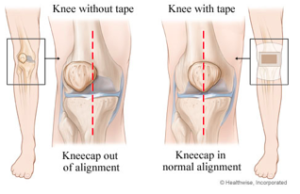
We can also show you how to tape your knee to provide relief in the short-term.

Screen-Shot-2016-09-26-at-2.03.24-PM-300x194.png

3.  Guidance on load management

We will give you advice on how to gradually re-load your tissues to safely protect your knee from future flare-ups.  We work with your coach or trainer to manage your return to doing what you love. 

4.  Building a personalised home exercise program

You are the most important part of the healing process and what you do is the most important part getting you better. 

We use the convenient Physitrack App to build your personalised home program with videos delivered to your smart phone.

5.  Movement Re-Training

Once your pain is under control we then watch how you move and optimise your movement patterning to decrease the chances of the knee pain returning.

People with patello-femoral pain are often hip flexor and quadricep dominant and need to learn how to activate the glutes and hamstrings.

We have some specific exercises to show you to help you fast track this process.

Is Knee Pain or Injury keeping you from being as active and healthy as you want?

Don't delay your treatment...

The occasional ache or pain may be nothing to worry about, but failing to pay attention to strong pain may end up causing you a lot of problems in the future. If knee pain is reducing your ability to take part in the activities your normally do, then it is time to get it looked at. In general, chronic knee pain or clicking that is affecting your life is a sign that something is wrong.

A serious problem will not correct itself, and left untreated, can result in more pain and irreversible damage. 

Bookings:

If you think we are the right fit for you and you wish to get relief right away, use our simple online booking system to make an appointment.  If you would prefer to speak to us directly,  call us 1300 657 813

References:

1.  Boling M, Padua D, Marshall S, et al. Gender differ- ences in the incidence and prevalence of patellofe- moral pain syndrome. Scand J Med Sci Sports 2010;20(5):725–30.

2. 

Wood L, Muller S, Peat G. The epidemiology of patellofemoral disorders in adulthood: A review of routine general practice morbidity recording. Prim Health Care Res Dev 2011;12(2):157–64.


static1.squarespace.com.jpg

Dan O'Grady is a results driven qualified Physiotherapist and member of the Australian Physiotherapy Association.  Dan has a special interest in treating knee pain.  He has been working in private practice for 15 years with (over 20,000 patient consults). He is passionate about helping people to move better, feel better and get back to doing what they love.

Other blogs to help with your knee pain and get your performing at your best:

Tendinopathy Update

The past weekend I attended Peter Malliaras's course, 'Mastering Lower Limb Tendinopathies'.

Peter is an Associate Professor at Monash University and has spent many years researching and working with people with tendon problems. 

In recent years there has been a lot of significant new research in the world of tendon rehab.

If you've ever had an issue with an ongoing tendon problem, you can understand how frustrating the long term pain and dysfunction can be. 

There is much conflicting advice and out dated treatment approaches that can contribute to the poor outcomes many people face with tendon injuries. 

Thankfully, Peter has put all of the latest based evidence into a comprehensible format and in this blog post I'd like to share just a little summary.

This blog would be particularly helpful if you suffer from ongoing pain in the:

  • Achilles tendon

  • Hamstring

  • Patella tendon

  • Hip pain/bursitis

  • Plantar fascia

What is a tendon?

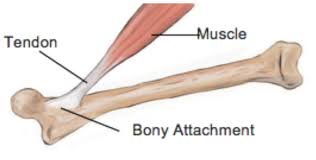
Tendons connect the muscle to bone.  They are made up primarily of collagen fibres.

In the lower limb, role of tendon is to absorb and release energy

Tendons are like springs that absorb stretching forces and then release energy when we move.


index.jpg


What causes tendon problems?

Tendons are very sensitive to changes in load. 

Essentially, tendons become injured when we over-load them too soon, or when demand exceeds capacity.

This can be from:

  • too much volume

  • too much intensity

  • change in footwear or surface

For example a runner may start to include sprinting or hill work too soon or increase mileage suddenly leading up to a big race.

High training load is not a risk for injuries, it's how you get there that is the important factor (i.e. avoiding acute spikes in training loads).

                   Tendons become damaged when demand exceeds their capacity

                   Tendons become damaged when demand exceeds their capacity

What is the difference between Tendinitis and Tendinopathy?

Tendinitis refers to the inflammation in the early stages of an injury. 

This is opposed to tendinopathy that refers to the process of degeneration that tendon goes through in response to chronic overload.

Recent research suggests a lot of what we previously thought of as tendon inflammation was actually related to tendinopathy.


Who is likely to suffer from a tendon problem?

Patella tendon (front of knee)

Usually occurs in younger people involved in jumping sports such as volleyball, basketball and football.  There is some evidence to suggest pathological tendon changes can begin in early adolescence if there excess load on the maturing collagen in the tendon.

Achilles tendon (back of heel)

Affects people across the lifespan, in particular long distance runners, sprinters, football and soccer players.  Often there is pain and stiffness that is worse on waking and when running. 

Gluteal tendon (side of hip)

Common in young females that are doing a lot of running or playing sport.  Also older women, especially around menopause or after post a hip injury / surgery.  Pain is often worse at night time, standing and walking.  There is some research showing a reduction in oestrogen can pre-dispose to tendinopathy. 

Hamstring tendon (back of hip)

Fast walkers, footballers, runners and people who do a lot of yoga are susceptible to hamstring tendinopathy.  They often experience pain on sitting, walking and bending forwards. 

_MG_5688.jpg

What are the key risk factors for developing tendinopathy?

One of the biggest risk factors for a tendon injury is a past injury (2-19x greater risk of injury).

According to the research, people with tendon problems are not getting the rehabilitation and re-building of capacity they need.

Often patients self-discharge when their pain has gone away

It is imperative for the treating clinician to educate the patient that rehabilitation is a two step process:

1.  Reducing pain and then

2.  Re-building capacity in the tissues to match the demands placed on them

Other systemic conditions that can increase the risk of developing tendon pain include:

  • Type 2 Diabetes ( 3 x risk)

  • High cholesterol

  • High blood pressure

  • Menopause

  • Obesity

  • Inflammatory arthropathies

Some other factors that put you at a higher risk of ongoing tendon pain:

  • unrealistic beliefs about likely healing time and optimal load management strategies

  • inaccurate beliefs pain e.g. avoiding movement due to fear or rupturing a tendon

  • too much passive treatment

  • reduced variability of movement / exercise

How is a diagnosis made? 

Tendon issues are diagnosed with a combination of history and physical testing

If you have a localised pain that gets worse with movement and you can recall a sudden change in loading, there is a good chance you have a tendon problem.

Do I need a scan? 

Ultrasound scans can be useful to confirm the diagnosis and rule out certain other conditions. 

(See below for more info on scans)

Recovery and Management :

1.  Education ... (And Addressing Beliefs About Pain)

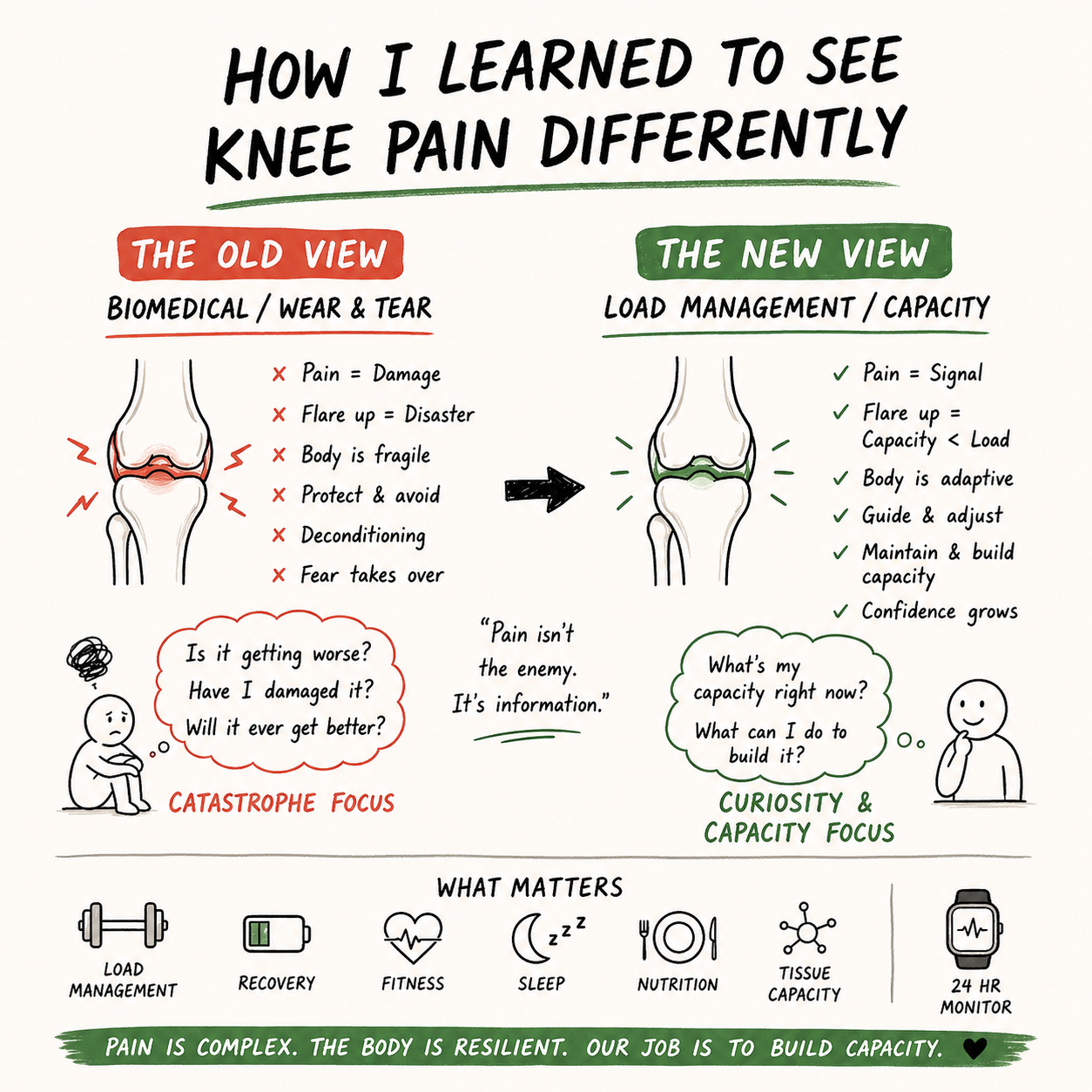
The long term goal is to create greater capacity in the tissues and this is your job, under the guidance of the physiotherapist looking after you.  

Manual therapy and dry needling does have a role to play in the short term to decrease pain and normalise muscle tone.

Credit: Jill Cook

Credit: Jill Cook

Pain and Pathology

You may have a scary sounding ultrasound report, with words such as 'severely degenerative'.

The bad news first.  Your scans will most probably always look terrible. 

Screen Shot 2017-11-28 at 10.29.25 am.png

Structurally over time, there will be no change, despite what you do in terms of treatment.

The good news:

Many high quality research studies have shown that there is no correlation between pain and structural changes on scans. 

Your tendon will always be degenerated.

However, the thing we do have control over is the mechanical adaptation in the tissues around the tendon, as well as optimising biomechanics and sharing the load around the body.

The goal of treatment is to build the capacity in the tissues surrounding the tendon so that it meets the demand and creates a buffer zone of relaxation.

Some very important things to remember:

"Pathology is common in people without pain, so it cannot be the cause of pain.

Worse pathology does not mean it will be harder for you to get better.

Tendon pathology often does not change, even when the pain resolves" - Peter Malliaras
 

Recovery Time Line

It's important to understand the nature of recovery is often a case of 2 steps forward and 1 step back pattern. 

It's normal for your pain levels to fluctuate.

If you can accept this, while continuing with your rehab, you will have a much greater chance of success.

Credit: Adam Meakins

Credit: Adam Meakins

2.  Reduce the load temporarily while reducing pain and inflammation

Pain can be brought under control by managing load and using ice and NSAID's. 

You may need to take a short break from any aggravating activities.

If you can't take anti-inflammatories you may need to look at your diet for areas to address inflammation.

How can isometrics help decrease pain?

Isometric refers to a static contraction of a muscle without any movement. 

For example the diagram below shows an isometric contraction of the calf/achilles:

Screen Shot 2017-11-28 at 10.38.20 am.png

Benefits of isometric contractions in tendon healing (Malliaras et al 2013):

  • Isometrics can decrease pain without adding excess load to the tendon.  

  • time under tension can be maximized to allow greater tendon strain, which is a likely stimulus for tendon adaptation

  • there is minimal soreness after doing isometrics, making them an ideal exercise 'during season'

  • loading can be performed in a range that is not painful and tendon compression can be minimized

The positive research around isometrics is in it's early stages and mainly focuses around the patella tendon.

3. Assess current load capacity and tolerance then begin re-loading the tendon.

Your Physiotherapist will take you through a comprehensive load capacity assessment and then develop a re-loading strategy.

This most important factor is that we progress the load over time to bring out positive adaptation and improved load tolerance. 

You will most likely meet with your Physio once per week in the short term to closely monitor and progress the load at a suitable rate.


4.  Clean up biomechanical issues and kinetic chain deficits

Biomechanical issues that may need addressing:

  • poor running technique

  • over-pronation

  • landing mechanics

  • postural issues

Kinetic chain deficits that may need addressing:

  • weak glutes

  • weak calves

  • weak quads

  • weak hamstrings, adductors

  • weak core

  • excessively tight muscles and joint restrictions

We will address these factors in the clinic.  By optimising your movement efficiency, you will increase the likelihood of successfully returning to doing what you love and staying pain-free.

Screen Shot 2017-11-28 at 10.42.00 am.png

5.  Progress the load and build capacity to greater than demand and gradually ease back into sport / exercise

This is where you get to really to push the boundaries of building capacity and gradually resume training and getting back to what you love. 

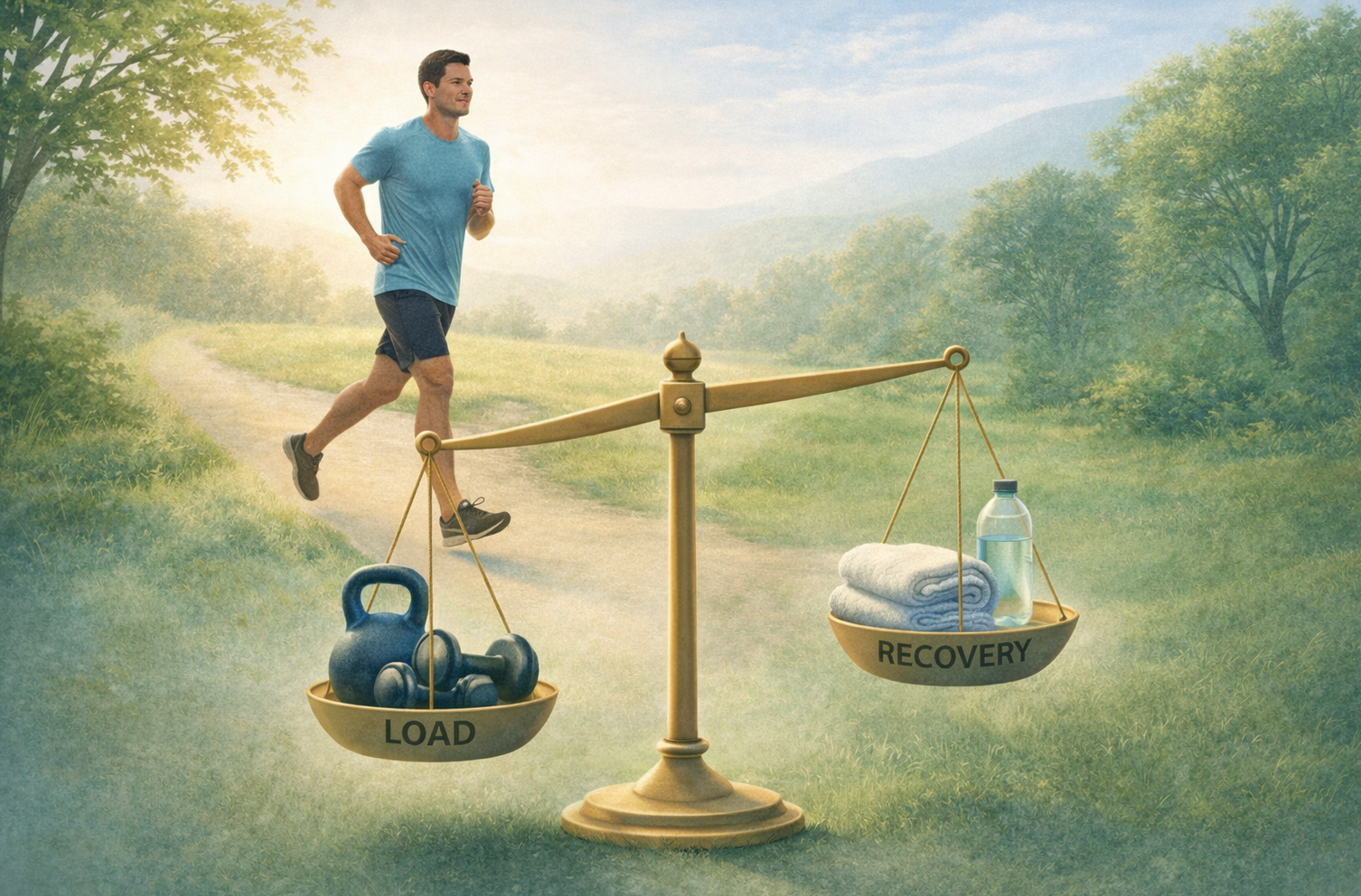
It's important at this stage to think not only about training but also proper recovery to allow the tissues to optimally adapt. 

You will want to optimise things like sleep, food / protein intake and foam rolling to keep your muscles tuned up.

This stage may weeks / months to fine tune and this is where we will monitor you loads to ensure a successful return.


In Summary - 5 Take Home Messages:

1.  There Is Hope

Despite your ugly looking scan and long-term pain, there is good evidence to suggest you can make a good recovery and get back to doing what you enjoy.

2.  It Takes Time

Tendons are resilient and adapt.  But you need to give them time. 

The time-frame on average to achieve this is a minimum of 12 weeks (but continual small improvements can still occur up to 5 years later).

3.  Get Assessed By A Physiotherapist

There is a significant degree of complexity involved in a tendon problem and a Physiotherapist, after a comprehensive assessment will be able to guide you towards a positive outcome. 

Screen Shot 2017-11-28 at 11.18.21 am.png

4.  Only Exercise Can Increase Load Tolerance

"Your tissue capacity will only be as good as the load you put on it" - Professor Jill Cook

The end game is to build your resilience and capacity to create a 'buffer' zone of relaxation. 

5.  Think Quality Of Movement Before Quantity

Movement capacity develops step by step

Small mindful movement of the muscle-tendon complex can improve efficiency and help ensure that your tendon issue becomes a thing of the past.

This is where Pilates can be very useful. 

Pilates provides the perfect environment for sharpening the mind-muscle connection and also introduces elements of movement variability that help improve resilience.

Screen Shot 2017-11-28 at 11.20.12 am.png


Bonus Tips:

  • PRP injections are a waste of time

  • Steroid injections can have short term benefit but 12 months later can end up worse due to weakening of the tendon.

  • Fast walking can cause hamstring issues

  • For a tendon problem, generally it's best to avoid stretching

  • Hip bursitis is treated with same strategies as gluteal tendinopathy

  • Extracorporal Shockwave therapy is worth trying (more info about this click visit our friends at Adelaide Podiatry)


Thanks for reading this summary and if you have any questions or comments, please feel free to email dan@kinfolkwellness.com.au

If you have a tendon issue you would like to have assessed, I'd be honoured to help guide you.  

You can make a booking using our easy online system here.