Knee

Why Strength Isn’t Enough, and What Will Really Fix Your Knee Pain

The Resilient Knee Project

Why Strength Isn’t Enough, and What Will Really Fix Your Knee Pain

When you’re struggling with knee pain, the first instinct is often to get stronger.

You’re told by well-meaning therapists, trainers, and experts, “If you’re in pain, just build up your muscles.”

And on the surface, that makes sense, right?

After all, strength equals stability, and stability should equal less pain.

But here’s the harsh truth: Strength alone won’t fix your pain.

In fact, if all you’re doing is trying to get stronger without addressing the bigger picture, you could be making things worse.

The Problem: Chasing Strength Without Capacity

Let’s use a simple metaphor: Imagine you’re really thirsty.

You grab a small cup and start filling it with water, but before long, it overflows—water spills everywhere.

That overflow? That’s your soreness, your pain.

Naturally, you think, “I need a stronger cup!”

So, you reinforce the cup, making it sturdier and thicker.

But here’s the catch—now, the cup is more rigid.

And what do we know about rigid things?

They’re more likely to crack or break under pressure.

This is exactly what happens when you chase strength without increasing your capacity.

Sure, you’re getting stronger, but without expanding how much your body can handle, you’re setting yourself up for failure.

When you overload a rigid, small cup (i.e., only focus on strength without increasing function), you’ll keep overflowing.

You might even break the cup.

What you really need is a bigger cup—more capacity, not just more strength.

The Truth About Strength: It’s Not the Only Answer

The “strength fixes pain” myth is powerful, but misleading.

Strength alone won’t solve the issue because it doesn’t address the root of the problem—your body’s capacity to handle load, recover, and adapt.

Without increasing your overall capacity—how well your muscles, tendons, bones, and joints can deal with stress and recover from it—focusing on strength alone makes you more fragile.

It’s like having a stronger but still small and rigid cup. Eventually, it will crack under the pressure of all the load you’re placing on it.

And here’s where it gets worse: The simplistic advice of “just get stronger” carries a subtle but harmful message that you’re “weak,” which can make you feel fragile.

It reinforces the idea that your body isn’t capable, and this fear creates a vicious cycle—making you feel more out of control over your symptoms.

The Solution: Capacity and Functional Resilience

What you truly need is functional capacity.

Instead of focusing on just getting stronger, focus on expanding your body’s ability to handle load without breaking down.

Think of this as building a bigger cup—one that can hold more without spilling over.

Capacity is your body’s ability to not only manage the load but also clear out the “waste” that builds up—like lactate, a byproduct of intense activity.

When your body can’t clear this waste efficiently, it contributes to soreness and pain.

Here’s the good news: Your body is designed to use lactate as fuel when your systems are functioning well.

And that’s where mitochondrial health comes in.

The more mitochondria you have, and the healthier they are, the better your body can clear waste and generate energy.

That’s capacity in action—building not just strength but the ability to handle and recover from stress over the long term.

The Resilient Knee Project: A Different, Innovative Approach to Knee Health

This is exactly what The Resilient Knee Project is all about.

It’s not just about building strength; it’s about creating resilience through functional capacity.

And running, believe it or not, is the perfect way to do this.

We need to respect the high load and force that running provides.

If channeled correctly, those forces can create resilience in your bones, muscles, tendons, and joints.

This is the real strength we’re after: genuine, long-term capacity.

Running builds capacity, but here’s the catch—it takes time.

Months, even years, to fully develop.

You won’t see immediate results.

This isn’t a quick-fix solution, but it’s one of the best long-term investments you can make in your body’s health.

What you’re developing is a powerful physical asset that will serve you for the rest of your life.

Once you build this capacity, you’ll have the knowledge and skills to manage your knee pain independently.

You’ll become the expert on your own body, and you’ll no longer need to rely on therapists or experts to “fix you” with simplistic solutions.

No more embarrassing narratives about being weak.

No more relying on medication, surgery, or avoiding movement out of fear.

Why the Desire for Strength is So Intuitive

Now, let’s address something important: the desire to get stronger is incredibly intuitive.

It makes sense—if you’re in pain or feeling fragile, getting stronger seems like the most logical response.

Most healthcare professionals will validate this desire, telling you strength is the solution.

But remember, strength alone isn’t enough.

Think of it like David vs. Goliath. David didn’t win by matching Goliath’s strength—he won with strategy.

And that’s exactly what you need: a strategy, not just a single-focus tactic like strength.

Your desire to be stronger is good, but we need to unpack it and turn that motivation into something more useful.

The real solution lies in building capacity.

This means not just lifting more weight but knowing when to push, when to back off, and how to recover. You’ll know exactly what to do when flare-ups occur (because let’s be real—they will still happen, just less often and less severe).

The Bottom Line: Invest in Capacity, Not Just Strength

If you’ve been chasing strength to fix your knee pain, it’s time to take a step back and look at the bigger picture.

Strength is important, but it’s only part of the solution.

What you need is to build capacity—giving your body the tools to handle life’s demands without breaking down.

Next time you feel the urge to just “get stronger,” remember: It’s not about building a stronger cup—it’s about building a bigger, more resilient one.

And if that sounds like a good plan to you, know this: It’s going to take investment.

But think of it as the best investment you’ll ever make.

Once you restore function and capacity, no one can take that away from you.

Imagine all the years ahead filled with physical activity, running races, hiking mountains, enjoying great times with friends and family—all without the fear of your knee letting you down, without being stuck in the endless cycle of rehab purgatory.

The Resilient Knee Project isn’t just about fixing pain.

It’s about empowering you to take control of your body, build long-term resilience, and live without limits.

Dan O'Grady is a results driven qualified Physiotherapist and member of the Australian Physiotherapy Association.  Dan has a special interest in treating knee pain.  He has been working in private practice for 20 years. He is passionate about helping people to move better, feel better and get back to doing what they love.

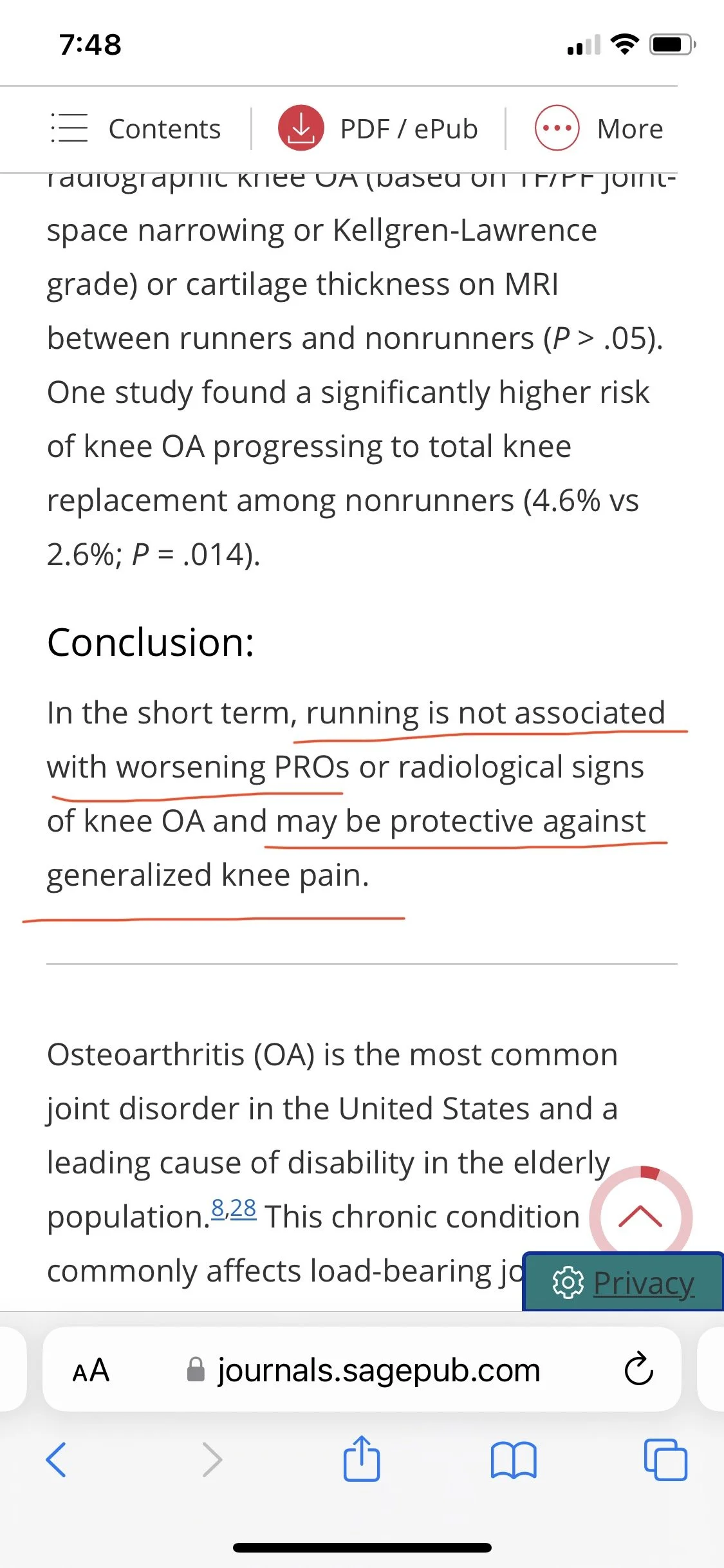
Running does not cause knee arthritis

Written by Daniel O’Grady, Knee Specialist Physio and Running Coach

Many runners worry that their favorite activity might lead to knee osteoarthritis (OA), but research suggests otherwise.

In fact, runners do not have a higher prevalence of knee OA compared to non-runners.

Let's explore why running might actually help your knees stay healthy.

The Misunderstood Relationship Between Running and Knee OA

  1. Cumulative Load vs. Peak Load:

    • Cumulative Load: The total stress your knees experience over time is more important for OA risk than the peak load during a single stride. Surprisingly, running has a low cumulative load compared to walking the same distance because of the shorter ground contact time and longer stride length.

    • Peak Load: While running involves higher peak loads, the overall stress on knee cartilage is managed better in runners due to their conditioned cartilage.

  2. Cartilage Conditioning:

    • Adaptation: Regular running conditions knee cartilage to handle the mechanical stresses of running. This means the cartilage becomes stronger and more resilient over time.

    • Mechanisms: Running increases the thickness and glycosaminoglycan content of knee cartilage, which helps in shock absorption and lubrication, making it more resistant to wear and tear.

  3. Misconceptions About Joint Loading:

    • High Peak Loads: Although peak knee joint loads in running are high, they do not necessarily lead to OA because the body adapts to these loads.

    • Dynamic Loading: The dynamic nature of running loads, with high rates of loading and unloading, is less harmful to cartilage compared to static loads, which are common in occupations requiring long periods of standing.

Key Takeaways

  • Low Risk for Runners: Recreational runners have a low risk of developing knee OA. Running might even protect against OA by conditioning the cartilage and keeping it healthy.

  • Stay Active: Regular, moderate running can be beneficial for your knee health. It's important to listen to your body and avoid excessive training volumes to prevent injuries.

By understanding these insights, runners can feel more confident that their passion for running is not only safe but also potentially beneficial for their knee health.

Keep running smart, and your knees will thank you!

If you’d like help on your journey getting back to running with knee pain or OA - join Physio Dan at The Resilient Knee Project - an innovative and unique program that gets you back to running and doing what you love - let’s get started today!

Journal link

Joint Loading in Runners Does Not Initiate Knee Osteoarthritis

Ross H. Miller

Exerc Sport Sci Rev. 2017;45(2):87-95

Can You Run with Knee OA?

Can You Run with Knee OA?

Here's What You Need to Know!

So you’ve just been diagnosed with knee osteoarthritis (OA)…

There may be many questions running through your head

  • What exactly is knee osteoarthritis (OA), and how did I get it?

  • What are the best treatment options for managing knee OA?

  • Will I need surgery at some point, or are there other alternatives?

  • Can I use knee OA as an excuse to skip leg day at the gym forever?

  • Can I blame knee OA for my newfound ability to predict the weather with my knees?


But if you’re like me, your most important concern will be:

“Can I still lace up my running shoes and hit the pavement?”

Well, you're not alone!

Many folks in your shoes (pun intended) are curious about the same thing.

Let's dive in and explore whether running with knee OA is a good idea, and how it might even help ease your knee pain.

Understanding Knee Osteoarthritis (OA):

First off, let's talk about knee OA.

The old view of OA is that it a result of wear and tear and inevitable joint degeneration.

This is known as the biomedical model and it offers an overly simplistic view that OA happens when the cartilage in your knee joint starts to wear down, causing pain, stiffness, and all-around discomfort.

It's not exactly an inspiring way to view the problem.

New view of OA:

Thankfully some very smart researchers, clinicians and doctors have come together to provide an updated explanation for knee OA and this involves taking a broader view of knee OA as an integrated whole body problem - that involves inflammation, metabolic health, immune system, diet, nutrition and even things like our beliefs and knowledge.

“Clinical outcomes in OA are influenced by multiple factors, including pain sensitization, psychological distress, muscle strength, BMI, inflammation, disease severity, and comorbidities,39 which may ultimately limit the maximum improvement in pain and function”.https://acrjournals.onlinelibrary.wiley.com/doi/full/10.1002/acr.25313

Essentially we have updated our model from a simple mechanical system (body is a machine that needs fixing) to seeing the body as an ecosystem (capable of positive adaptive and growth given the optimal conditions) that is capable of regenerating given the optimal environmental conditions.

This new approach is no shortage of a revolution and paradigm shift in how we see the body and it’s potential for healing.

It opens the door to many treatment options that were previously not even considered until very recently.

Benefits of Running with Knee OA:

Believe it or not, running can actually have some perks for folks with knee OA:

  1. Improved Joint Function: Running can help keep your knee joints flexible and moving smoothly, which is super important when you've got OA.

  2. Strengthening Muscles: When you run, you're not just working out your legs – you're also giving those supporting muscles around your knees a good workout. It's like building a sturdy support system for your knees!

  3. Weight Management: Running is a great way to burn calories and keep your weight in check. And when you're carrying around less weight, there's less stress on your knee joints.

  4. Mood Boost: Ever heard of a runner's high? It's a real thing! Running releases feel-good hormones in your brain, which can help lift your mood and ease stress – definitely a win-win!

Considerations for Running with Knee OA:

Before you lace up those shoes and hit the pavement, here are a few things to keep in mind:

  1. Talk to a Pro: It's always a good idea to chat with a healthcare pro before starting any new exercise routine, especially if you've got knee OA. They can give you the lowdown on whether running is safe for you.

  2. Take It Slow: Start with a gentle jog or brisk walk, and gradually build up your speed and distance over time. Rome wasn't built in a day, and neither is a runner!

  3. Shoe Game Strong: Invest in a good pair of running shoes with plenty of cushioning and support. Your knees will thank you!

  4. Watch Your Form: Pay attention to your running technique – aim for a mid-foot strike, keep your posture upright, and try to land softly to reduce impact on your knees.

  5. Mix It Up: Running is great, but it's not the only game in town! Mix in some strength training and flexibility exercises to give your knees a well-rounded workout.

Could running actually be the BEST way to protect your knees?

A recent study with 14,000 participants revealed some fascinating insights:

  • Non-runners had a HIGHER prevalence of knee pain.

  • Running could actually PROTECT your knees by inducing beneficial adaptations through mechanical loading.

But here’s the kicker:

When we try to shield our knees by avoiding movement, we might actually be reinforcing a cycle of pain and fear.

Running, under proper guidance, sends a powerful message to the brain that everything’s OK!

Here are three tips to keep you going strong:

- Maintain a high cadence of 170-180 steps per minute to reduce stress on your knees.

- Invest in well-supported shoes to cushion impact and provide stability.

- Strike a balance between walking and jogging to build endurance while minimizing strain.

Demystifying Noisy Knees

Demystifying Noisy Knees: A Physiotherapist's Perspective

Noisy knees, characterized by sounds such as cracking, clicking, and popping, are a common phenomenon affecting up to 70% of the population.

Recent research conducted by La Trobe University has shed light on this prevalent issue, highlighting the impact of online misinformation on individuals' health choices.

In this blog, we will delve into the findings of this study, led by Dr. Danilo de Oliveira Silva, and explore the implications for both patients and healthcare professionals.

The Prevalence and Misconceptions of Knee Crepitus

Knee crepitus is a term used to describe the sounds that occur when the knee joint moves.

Despite its widespread occurrence, there is a significant lack of credible information available on the internet.

Dr. de Oliveira Silva and his team at the La Trobe Sport and Exercise Medicine Research Centre have found that many people are influenced by this misinformation, leading them to make poor health decisions.

The Impact of Online Misinformation

The internet is a go-to source for health information for many individuals.

However, the study conducted by La Trobe University reveals that over half of the websites evaluated did not provide evidence-based information.

This misinformation has led to a variety of misconceptions about knee crepitus, with some people believing that these sounds are harmful to their health or a cause for embarrassment.

The Research Findings

The research team conducted a comprehensive appraisal of the top 20 URLs from two popular search engines, Google and Bing. Out of 120 websites, 51 were evaluated for credibility, accuracy, and evidence support.

The results were alarming, with a significant number of websites providing information that was not backed by research evidence.

The study found that many websites suggested treatment options such as exercise, medication, passive treatments (brace, ice, splints), and rest, despite there being no research evidence to support these recommendations. This highlights the need for caution when seeking web-based information about knee crepitus.

Moving Forward

Dr. de Oliveira Silva emphasizes the importance of conducting further clinical studies to explore the impact of knee crepitus on individuals' health.

He advocates for the inclusion of patients and health professionals in designing research questions to ensure that the information provided is relevant and credible.

Take Home Message

As a physiotherapist, it is crucial to guide our patients towards evidence-based information and help them make informed decisions about their health.

The study conducted by La Trobe University serves as a reminder of the pervasive nature of online misinformation and the need for critical evaluation of web-based health information.

Let us commit to providing accurate, reliable, and evidence-based information to our patients, empowering them to take control of their health and well-being.

References:

Study in Science Direct: “My knee is cracking” – What information is available on the internet about it? A systematic appraisal of the credibility, readability and accuracy of online information about knee crepitus. Dr. Danilo de Oliveira Silva, La Trobe Sport and Exercise Medicine Research Centre.