Knee

Running does not cause knee arthritis

Written by Daniel O’Grady, Knee Specialist Physio and Running Coach

Many runners worry that their favorite activity might lead to knee osteoarthritis (OA), but research suggests otherwise.

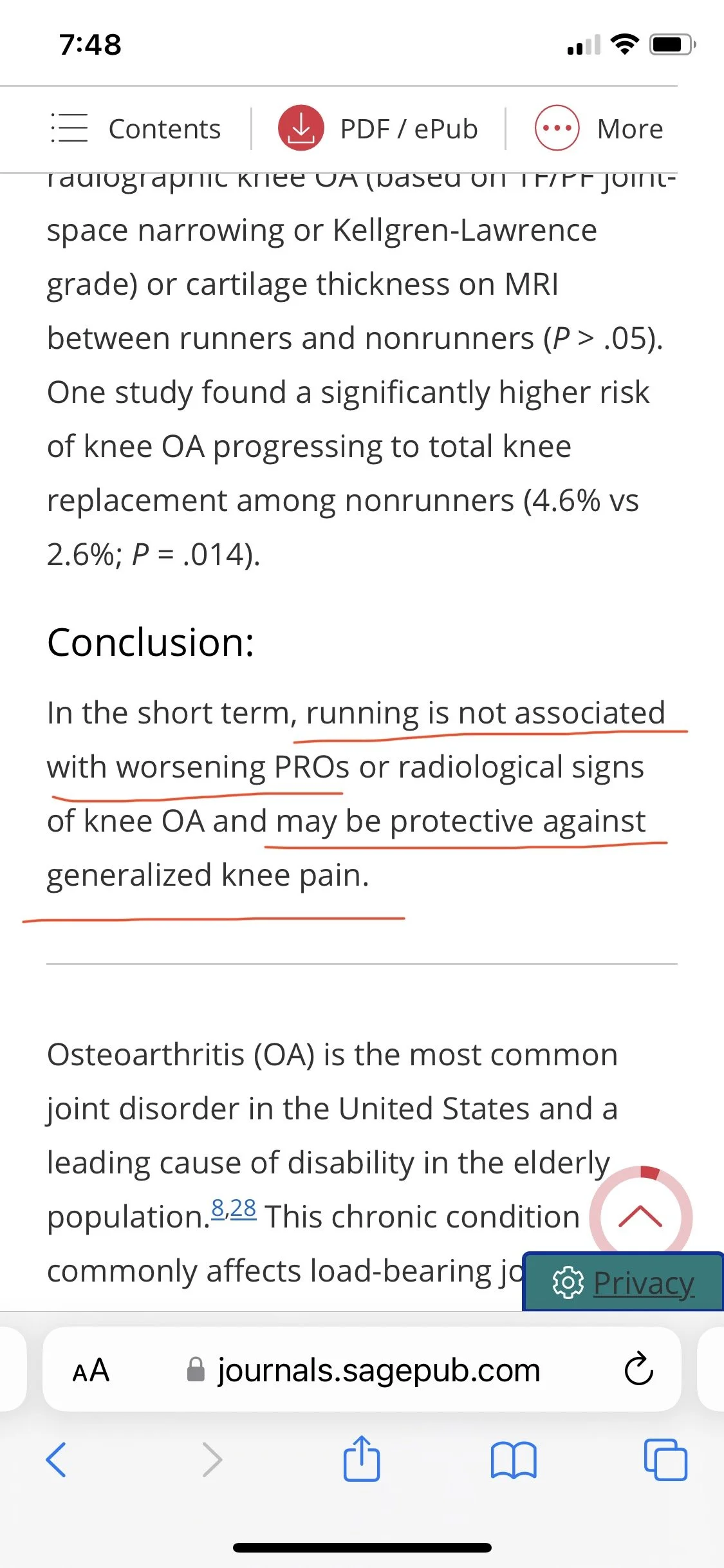
In fact, runners do not have a higher prevalence of knee OA compared to non-runners.

Let's explore why running might actually help your knees stay healthy.

The Misunderstood Relationship Between Running and Knee OA

  1. Cumulative Load vs. Peak Load:

    • Cumulative Load: The total stress your knees experience over time is more important for OA risk than the peak load during a single stride. Surprisingly, running has a low cumulative load compared to walking the same distance because of the shorter ground contact time and longer stride length.

    • Peak Load: While running involves higher peak loads, the overall stress on knee cartilage is managed better in runners due to their conditioned cartilage.

  2. Cartilage Conditioning:

    • Adaptation: Regular running conditions knee cartilage to handle the mechanical stresses of running. This means the cartilage becomes stronger and more resilient over time.

    • Mechanisms: Running increases the thickness and glycosaminoglycan content of knee cartilage, which helps in shock absorption and lubrication, making it more resistant to wear and tear.

  3. Misconceptions About Joint Loading:

    • High Peak Loads: Although peak knee joint loads in running are high, they do not necessarily lead to OA because the body adapts to these loads.

    • Dynamic Loading: The dynamic nature of running loads, with high rates of loading and unloading, is less harmful to cartilage compared to static loads, which are common in occupations requiring long periods of standing.

Key Takeaways

  • Low Risk for Runners: Recreational runners have a low risk of developing knee OA. Running might even protect against OA by conditioning the cartilage and keeping it healthy.

  • Stay Active: Regular, moderate running can be beneficial for your knee health. It's important to listen to your body and avoid excessive training volumes to prevent injuries.

By understanding these insights, runners can feel more confident that their passion for running is not only safe but also potentially beneficial for their knee health.

Keep running smart, and your knees will thank you!

If you’d like help on your journey getting back to running with knee pain or OA - join Physio Dan at The Resilient Knee Project - an innovative and unique program that gets you back to running and doing what you love - let’s get started today!

Learn more

Journal link

Joint Loading in Runners Does Not Initiate Knee Osteoarthritis

Ross H. Miller

Exerc Sport Sci Rev. 2017;45(2):87-95

Can You Run with Knee OA?

Can You Run with Knee OA?

Here's What You Need to Know!

So you’ve just been diagnosed with knee osteoarthritis (OA)…

There may be many questions running through your head

  • What exactly is knee osteoarthritis (OA), and how did I get it?

  • What are the best treatment options for managing knee OA?

  • Will I need surgery at some point, or are there other alternatives?

  • Can I use knee OA as an excuse to skip leg day at the gym forever?

  • Can I blame knee OA for my newfound ability to predict the weather with my knees?


But if you’re like me, your most important concern will be:

“Can I still lace up my running shoes and hit the pavement?”

Well, you're not alone!

Many folks in your shoes (pun intended) are curious about the same thing.

Let's dive in and explore whether running with knee OA is a good idea, and how it might even help ease your knee pain.

Understanding Knee Osteoarthritis (OA):

First off, let's talk about knee OA.

The old view of OA is that it a result of wear and tear and inevitable joint degeneration.

This is known as the biomedical model and it offers an overly simplistic view that OA happens when the cartilage in your knee joint starts to wear down, causing pain, stiffness, and all-around discomfort.

It's not exactly an inspiring way to view the problem.

New view of OA:

Thankfully some very smart researchers, clinicians and doctors have come together to provide an updated explanation for knee OA and this involves taking a broader view of knee OA as an integrated whole body problem - that involves inflammation, metabolic health, immune system, diet, nutrition and even things like our beliefs and knowledge.

“Clinical outcomes in OA are influenced by multiple factors, including pain sensitization, psychological distress, muscle strength, BMI, inflammation, disease severity, and comorbidities,39 which may ultimately limit the maximum improvement in pain and function”.https://acrjournals.onlinelibrary.wiley.com/doi/full/10.1002/acr.25313

Essentially we have updated our model from a simple mechanical system (body is a machine that needs fixing) to seeing the body as an ecosystem (capable of positive adaptive and growth given the optimal conditions) that is capable of regenerating given the optimal environmental conditions.

This new approach is no shortage of a revolution and paradigm shift in how we see the body and it’s potential for healing.

It opens the door to many treatment options that were previously not even considered until very recently.

Benefits of Running with Knee OA:

Believe it or not, running can actually have some perks for folks with knee OA:

  1. Improved Joint Function: Running can help keep your knee joints flexible and moving smoothly, which is super important when you've got OA.

  2. Strengthening Muscles: When you run, you're not just working out your legs – you're also giving those supporting muscles around your knees a good workout. It's like building a sturdy support system for your knees!

  3. Weight Management: Running is a great way to burn calories and keep your weight in check. And when you're carrying around less weight, there's less stress on your knee joints.

  4. Mood Boost: Ever heard of a runner's high? It's a real thing! Running releases feel-good hormones in your brain, which can help lift your mood and ease stress – definitely a win-win!

Considerations for Running with Knee OA:

Before you lace up those shoes and hit the pavement, here are a few things to keep in mind:

  1. Talk to a Pro: It's always a good idea to chat with a healthcare pro before starting any new exercise routine, especially if you've got knee OA. They can give you the lowdown on whether running is safe for you.

  2. Take It Slow: Start with a gentle jog or brisk walk, and gradually build up your speed and distance over time. Rome wasn't built in a day, and neither is a runner!

  3. Shoe Game Strong: Invest in a good pair of running shoes with plenty of cushioning and support. Your knees will thank you!

  4. Watch Your Form: Pay attention to your running technique – aim for a mid-foot strike, keep your posture upright, and try to land softly to reduce impact on your knees.

  5. Mix It Up: Running is great, but it's not the only game in town! Mix in some strength training and flexibility exercises to give your knees a well-rounded workout.

Could running actually be the BEST way to protect your knees?

A recent study with 14,000 participants revealed some fascinating insights:

  • Non-runners had a HIGHER prevalence of knee pain.

  • Running could actually PROTECT your knees by inducing beneficial adaptations through mechanical loading.

But here’s the kicker:

When we try to shield our knees by avoiding movement, we might actually be reinforcing a cycle of pain and fear.

Running, under proper guidance, sends a powerful message to the brain that everything’s OK!

Here are three tips to keep you going strong:

- Maintain a high cadence of 170-180 steps per minute to reduce stress on your knees.

- Invest in well-supported shoes to cushion impact and provide stability.

- Strike a balance between walking and jogging to build endurance while minimizing strain.

Demystifying Noisy Knees

Demystifying Noisy Knees: A Physiotherapist's Perspective

Noisy knees, characterized by sounds such as cracking, clicking, and popping, are a common phenomenon affecting up to 70% of the population.

Recent research conducted by La Trobe University has shed light on this prevalent issue, highlighting the impact of online misinformation on individuals' health choices.

In this blog, we will delve into the findings of this study, led by Dr. Danilo de Oliveira Silva, and explore the implications for both patients and healthcare professionals.

The Prevalence and Misconceptions of Knee Crepitus

Knee crepitus is a term used to describe the sounds that occur when the knee joint moves.

Despite its widespread occurrence, there is a significant lack of credible information available on the internet.

Dr. de Oliveira Silva and his team at the La Trobe Sport and Exercise Medicine Research Centre have found that many people are influenced by this misinformation, leading them to make poor health decisions.

The Impact of Online Misinformation

The internet is a go-to source for health information for many individuals.

However, the study conducted by La Trobe University reveals that over half of the websites evaluated did not provide evidence-based information.

This misinformation has led to a variety of misconceptions about knee crepitus, with some people believing that these sounds are harmful to their health or a cause for embarrassment.

The Research Findings

The research team conducted a comprehensive appraisal of the top 20 URLs from two popular search engines, Google and Bing. Out of 120 websites, 51 were evaluated for credibility, accuracy, and evidence support.

The results were alarming, with a significant number of websites providing information that was not backed by research evidence.

The study found that many websites suggested treatment options such as exercise, medication, passive treatments (brace, ice, splints), and rest, despite there being no research evidence to support these recommendations. This highlights the need for caution when seeking web-based information about knee crepitus.

Moving Forward

Dr. de Oliveira Silva emphasizes the importance of conducting further clinical studies to explore the impact of knee crepitus on individuals' health.

He advocates for the inclusion of patients and health professionals in designing research questions to ensure that the information provided is relevant and credible.

Take Home Message

As a physiotherapist, it is crucial to guide our patients towards evidence-based information and help them make informed decisions about their health.

The study conducted by La Trobe University serves as a reminder of the pervasive nature of online misinformation and the need for critical evaluation of web-based health information.

Let us commit to providing accurate, reliable, and evidence-based information to our patients, empowering them to take control of their health and well-being.

References:

Study in Science Direct: “My knee is cracking” – What information is available on the internet about it? A systematic appraisal of the credibility, readability and accuracy of online information about knee crepitus. Dr. Danilo de Oliveira Silva, La Trobe Sport and Exercise Medicine Research Centre.

Case Study: Navigating Knee Pain - A Tale of Two Approaches

Case Study: Navigating Knee Pain - A Tale of Two Approaches

Two active 60-year-old women found themselves facing similar knee pain issues.

They both experienced pain while walking, yet they could straighten their knees without difficulty.

Seeking answers, they both consulted their GP and underwent MRI scans that revealed a medial meniscus tear and moderate osteoarthritis (OA).

What unfolded next showcased the significant impact of different medical approaches and their outcomes.

Patient A's Journey: The Surgical Solution

Patient A's GP referred her directly to an orthopedic surgeon, who suggested an arthroscopic procedure to address the meniscus tear and OA. Unaware of evidence-based guidelines that advised against surgery for these conditions, the surgeon proceeded with the procedure. Patient A, while anxious about the out-of-pocket expense, trusted the expert's recommendation.

Eight weeks after the surgery, Patient A continued to experience swelling, pain, and difficulty walking. Following the surgeon's advice, she sought physiotherapy, which prescribed strengthening exercises like squats and lunges. However, these exercises worsened her pain. Determined to push through and follow the expert's guidance, she endured discomfort with the belief of "no pain, no gain."

Patient B's Journey: An Informed Approach

Patient B took a different route. Consulting a physiotherapist well-versed in up-to-date research, she received an enlightening perspective. The physiotherapist examined her medical history and the onset of pain. Noticing that her pain emerged after an active hiking holiday involving intense hill walking, the physiotherapist identified this as a "spike in load," temporarily overloading the knee cap.

Contrary to Patient A's diagnosis, the physiotherapist concluded that the medial meniscus tear was likely unrelated to her pain. The pain's location, under the knee cap and stemming from increased activity, indicated patellofemoral pain on a backdrop of knee degeneration.

Armed with a well-informed diagnosis, the treatment strategy focused on inflammation reduction, temporary avoidance of compression-triggering positions, and gentle exercises.

Treatment and Recovery

Patient B diligently followed the recommended course of action. She used ice packs and engaged in pool exercises to minimize knee compression. Avoiding positions like squats and lunges, she commenced gentle calf raises, bridges, and hip and core exercises. After just one week, her pain significantly subsided. Expert manual therapy also eased tension in surrounding muscles.

As Patient B progressed, the physiotherapist cleared her to walk on flat ground, recommending supportive sneakers that suited her foot structure. Encouraging confident walking with a short step to alleviate knee strain, the physiotherapist offered pain guidance—green (0-3/10) is acceptable, orange (4-5/10) prompts caution, and red (6-10/10) indicates a need to stop.

Outcome and Insights

After eight weeks, Patient B experienced remarkable recovery.

The informed diagnosis, evidence-based treatment, and skilled physiotherapy led to her enhanced understanding of her knee and improved self-care practices. Her journey exemplifies the power of knowledge and personalized care in achieving positive outcomes.

This case study illuminates the divergent paths that can emerge in knee pain management.

It underscores the significance of accurate diagnosis, evidence-based treatment, and patient education. While Patient A navigated a surgical approach with unexpected challenges, Patient B's informed journey emphasized the potential for successful recovery through understanding, tailored therapy, and guided rehabilitation.

Top 5 Learnings from a Tale of Knee Pain:

  1. Accurate Diagnosis is Key: One of the most crucial takeaways is the significance of an accurate diagnosis. While both patients had similar initial symptoms, the patient who received an accurate diagnosis experienced effective treatment that targeted the root cause of their pain. Understanding the underlying issue is essential for tailored and successful rehabilitation.

  2. Evidence-Based Treatment: The case study underscores the importance of evidence-based treatment. The physiotherapist who based their approach on the latest research led their patient to a quicker recovery. Being informed about evidence-based guidelines can empower patients to make informed decisions about their treatment options.

  3. Individualized Approach: Every individual's experience with pain is unique. The physiotherapist took the time to analyze each patient's history and symptoms to determine the most appropriate treatment plan. This personalized approach recognizes that one size doesn't fit all when it comes to healthcare.

  4. Holistic Healing: The tale highlights the importance of considering both physical and psychological factors in the recovery process. The patient who received accurate information and an appropriate treatment plan experienced not only physical relief but also gained knowledge and confidence in managing their condition.

  5. Active Participation: The case illustrates the importance of active patient participation in their own recovery. The patient who was educated about their condition and treatment plan became proactive in their healing journey. Open communication with healthcare professionals and adherence to tailored exercises and recommendations play a pivotal role in successful outcomes.

In conclusion, this tale of knee pain emphasizes the significance of accurate diagnosis, evidence-based treatment, individualized care, holistic healing, and active patient participation. It serves as a reminder that informed decisions and a comprehensive approach to healthcare can lead to improved outcomes and a more empowered, knowledgeable patient.