
PNE

The Paradigm Shift in Pain
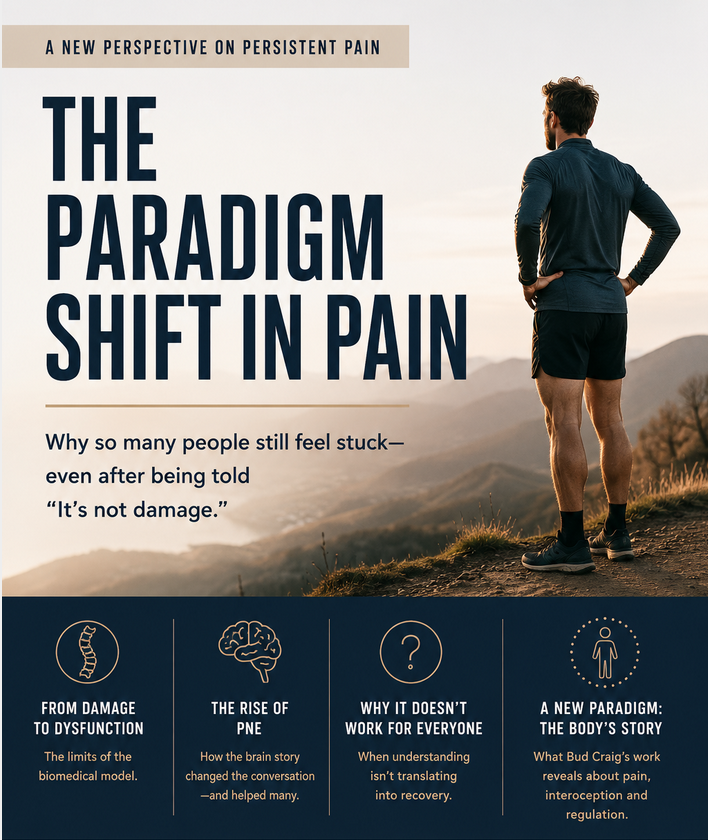
The Paradigm Shift in Pain

Why “Making Sense” Has Been So Confusing

If you’ve had persistent pain, chances are you’ve been on a journey to make sense of it.

At first, the story is simple:

“Something is damaged.”

That’s the traditional biomedical model.

Find the structure.
Fix the structure.
Problem solved.

And to be fair — that model worked incredibly well for many things:

  • fractures

  • infections

  • surgical emergencies

  • major tissue injuries

But when it came to persistent musculoskeletal pain, the picture became far less clear.

A huge percentage of people continued to have pain long after tissues were expected to heal.

Around 1 in 5 adults now live with chronic pain.

Many people with back pain, neck pain, tendon pain or knee pain never fully returned to normal despite scans, treatments, injections or even surgery.

In some cases, the endless search for “the damaged part” may have even amplified fear, hypervigilance and disability.

That’s when cracks started to appear in the old paradigm.

Then Came the Big Shift

Over the last 10–15 years, a new model took over.

Pain wasn’t about damage anymore.

It was about the brain.

This shift—driven by researchers like Lorimer Moseley—was huge.

And to be fair, it helped a lot of people.

  • It reduced fear

  • It got people moving again

  • It broke the “fragile body” narrative

For many, it was a necessary correction.

But Something Strange Happened

The PNE model quickly became the dominant narrative in modern pain rehabilitation.

Because it was linked to neuroscience and the brain, it carried an immediate sense of authority and sophistication.

In some circles, it almost became assumed that a “brain-based” explanation must automatically be more advanced and more correct.

But as time went on, many clinicians and patients quietly started noticing something important:

understanding pain intellectually didn’t always translate into meaningful recovery physically.

And like most dominant ideas, it started to stretch beyond its limits.

Pain became explained as:

“Your brain is overprotective”
“Your nervous system is misfiring”
“It’s a learned response”

For some people, this clicked.

For others, it didn’t.

The Quiet Frustration

If you’re in that second group, you might recognise this:

  • You understand the explanation

  • You agree with it intellectually

  • But your body hasn’t changed much

And when it doesn’t work, the explanation subtly turns back on you:

  • “You haven’t fully let go of fear”

  • “You’re still processing it wrong”

That’s a tough place to be.

Because now you’re not just in pain…

You’re also not doing the model properly

A Line That Stopped Me in My Tracks

Reading Nassim Nicholas Taleb, I came across this:

“When it comes to narratives, the brain seems to be the last province of the theoretician-charlatan… Add ‘neuro’ to something and it suddenly becomes more convincing… yet the brain is too complex for that.”

That hit hard.

Because it explained something I had been feeling for years but couldn’t articulate.

The Problem Wasn’t That PNE Was Wrong

It’s that it became too neat.

Too explanatory.
Too confident.

As if we could reduce something as complex as pain to:

“The brain thinks you’re in danger”

That’s a compelling story.

But it’s still… a story.

The Shift That Changed My Thinking

Then I came across the work of neuroscientist Bud Craig.

And his book How Do You Feel?.

It didn’t give me a better story.

It gave me something more useful:

A way to stop over-explaining… and start observing

A Different Kind of Understanding

Craig’s model is simpler, but deeper:

Pain is a feeling that reflects the state of your body.

Not just your brain.
Not just your tissues.

Your whole system.

This Changes Everything

Instead of asking:

“Why does my brain think I’m in danger?”

You start asking:

“What is my body actually dealing with right now?”

  • load

  • fatigue

  • stress

  • poor sleep

  • deconditioning

  • inconsistent movement

Pain becomes less about interpretation…

…and more about capacity vs demand

Less Theory, More Reality

This is where Taleb’s thinking becomes useful again.

He writes about avoiding over-explanation and focusing on:

Noticing the PATTERNS in your body over time

In other words:

  • What happens when you walk more?

  • What happens when you sleep better?

  • What happens when you overload your system?

Not in theory.

But in reality.

This Is the Shift

From:

“What does this pain mean?”

To:

“What does my system do in response to what I’m doing?”

How I Work Now (Because of This)

I’m far less interested in:

  • perfect explanations

  • complex narratives

  • convincing you of a model

And far more interested in:

  • what you can do today

  • how your body responds tomorrow

  • what patterns emerge over time

We Use Simple Anchors

Not guesswork.

Things like:

  • walking or running tolerance

  • 24-hour response to activity

  • energy levels

  • recovery patterns

Because your body doesn’t lie.

No Ideology. Just Feedback.

We’re not trying to:

  • fix a structure

  • retrain a brain

We’re trying to:

help your system handle more… and see what happens

Why This Feels Different

Because it removes pressure.

You don’t need to:

  • think perfectly

  • believe the right thing

  • interpret your pain correctly

You just need to:

observe, adjust, and build capacity

Final Thought

The biggest shift in pain isn’t from body → brain.

It’s from:

theory → reality

Takeaway

Pain is not something you need to perfectly understand.
It’s something you need to work with.

And the more your system can handle…

The less it needs to shout.

Is It Time for a New Pain Model?

Is It Time for a New Pain Model?

In the early 2000s, pain neuroscience education (PNE) emerged as a revolutionary approach to understanding pain, spearheaded by prominent figures like Lorimer Mosley and David Butler.

Their work shifted the conversation away from a purely structural perspective and introduced the world to the concept that pain is not solely a result of tissue damage, but also a brain-driven phenomenon.

For some in the rehab profession, this helped us move beyond simplistic reductionist narratives (some other practitioners continued the narrative - see below).

How many overly simplistic nocebic inducing narratives could you fit in one physiotherapy session?

This was an exciting revelation at the time, and it gave clinicians and patients alike a new way to explain chronic pain.

However, as the years have passed, it’s become increasingly clear that PNE, while groundbreaking, may not have fully lived up to its promise.

Many have “drunk the Kool-Aid,” so to speak, fully subscribing to the PNE narrative without recognizing its limitations.

As a result, it may be time for a new explanatory model—one that embraces both the brain and the body in a more profound and grounded way.

Enter Bud Craig’s homeostatic model.

The Cognitive Focus of PNE: A Double-Edged Sword

Butler and Mosley’s PNE revolution gave us the gift of understanding the brain's role in pain perception.

It showed that pain is a complex experience that involves more than just signals from the body—our thoughts, beliefs, and prior experiences shape how we experience pain.

This has led to cognitive-based interventions aimed at reshaping our understanding of pain, helping patients reframe their pain experience and reduce fear.

But this approach has its downsides.

The heavy focus on cognition—the idea that it’s all in the brain—can stigmatize patients, making them feel like their brain is "broken" or diseased.

Just today I heard on the Curable podcast (link here - 38 min mark) Sophie Hawley-Weld discuss her negative experience with PNE as a stand alone approach - “It made me feel crazy, because I did ALL the things!”

Lisa Feldman Barrett points out in her book How Emotions Are Made:

“Scientists now consider chronic pain to be a brain disease with its roots in inflammation.”

Therapists, too, can get stuck in this model, sometimes doubling down when their approach doesn’t yield results, leading to frustration and cognitive dissonance on both sides.

While PNE has helped many, its reductionist trap—the idea that pain is purely a cognitive or brain-based experience—can leave patients feeling confused, alienated, and in some cases, harmed.

The Quiet Work of Bud Craig: A Model Ready for Its Time

While PNE experts have been front and center, promoting their work as being of the highest evidence-based standard, Bud Craig has worked quietly and diligently in his lab for over two decades.

Without any fanfare or jumping to premature conclusions, Craig has steadily built his homeostatic model of pain, focusing on understanding how the brain and body interact to maintain balance. His approach has been one of careful observation and deep research, avoiding the sensationalism that often accompanies new theories.

Unlike the self-promotion that has often characterized the PNE movement, Craig’s work has been humble yet profound.

While PNE experts have confidently marketed their approach and, at times, looked down on therapists who use what they consider to be outdated modalities, Craig has taken a more measured, thoughtful path.

This divide between the PNE camp and other healthcare professionals has created divisions within the profession that threaten to tear it apart. As the PNE model gained traction, those who embraced different methods, even those rooted in manual therapy or movement-based approaches, have often been labeled as being behind the times or lacking evidence.

This division is unhealthy.

When experts adopt a fixed stance, particularly when that stance dominates the conversation, it can prevent the evolution of new ideas.

The rigid adherence to the neuromatrix theory has made it difficult for PNE proponents to integrate other valuable insights, particularly those that focus on the body’s physiological processes.

Bud Craig’s Homeostatic Model: A More Balanced Approach

This is where Bud Craig’s homeostatic model offers a refreshing alternative.

Craig’s model doesn’t disregard the brain’s role, but it brings the body back into the equation in a more meaningful way. His model focuses on interoception—the way the brain perceives signals from inside the body—and homeostasis, or the body's ability to maintain internal balance.

Craig suggests that pain emerges from the brain's interpretation of signals related to disruptions in homeostasis.

In other words, pain is a result of the body trying to maintain balance, involving not just cognitive processes but also metabolic health, the immune system, and the autonomic nervous system.

This multi-dimensional approach goes beyond the brain to include a broader understanding of the body's physiological state.

Why PNE Has Reached Its Limits

The current PNE model, with its strong focus on the brain, misses out on these broader dimensions. While it’s been helpful for some, it has also led to iatrogenic harm—the unintended negative consequences of treatment.

Patients who don’t respond to PNE can feel as though their brain is at fault, or that they’re failing to think positively enough to overcome their pain. This can lead to a sense of disempowerment, where patients feel like they’re not in control of their own healing.

On the flip side, therapists who are deeply invested in the neuromatrix theory of pain, popularized by PNE, can become stuck in their thinking.

They may struggle to embrace newer models like Craig’s, falling into expert bias and resisting change due to their commitment to a theory that no longer fully explains the complexity of pain.

Big organizations or thought leaders who have built their careers on the neuromatrix theory may find it difficult to pivot, even when emerging evidence suggests a new direction is needed.

The Risk of Reductionism

When we boil down pain to a purely cognitive process, we risk oversimplifying a very complex experience.

Pain is not just in the mind, and it’s not just in the body—it’s an emergent experience that arises from the brain’s interpretation of the body’s internal state.

PNE’s reductionist approach may have been a necessary stepping stone, but it’s clear now that it’s not enough.

We need a model that honors the complexity of pain—one that integrates the brain, body, and emotions.

A New Paradigm for Pain: Bud Craig’s Homeostatic Model

Bud Craig’s homeostatic model offers the kind of paradigm shift that the pain world desperately needs.

His model moves beyond the brain-centric view of pain and looks at how pain is a signal of the body’s struggle to maintain balance.

It integrates brain and body, cognition and physiology, offering a more multi-dimensional and empowering view of pain.

This model suggests that pain is not just about faulty neural circuits or maladaptive thoughts but is a multi-dimensional signal that can arise from metabolic imbalance, poor immune function, or disruptions in the autonomic nervous system.

In this way, it respects the body's role in pain, and it offers patients a more empowering framework for understanding their pain and healing.

Instead of being told that their brain is “the problem,” patients can see how their body and brain work together to maintain balance.

Time for a New Direction

As with any scientific revolution, there comes a time when we must move forward. Karl Popper’s philosophy reminds us that science should be open to change, that we must always be ready to discard old theories when new evidence challenges them.

The PNE revolution, while groundbreaking, may now need to give way to a more nuanced, integrative approach. The homeostatic model offers a new direction—one that respects the brain’s role but also fully embraces the body’s physiological contributions to pain.

It’s time for a new pain model—one that’s more grounded in science, one that empowers patients rather than stigmatizing them, and one that helps therapists and patients alike see the bigger picture.

The time for Bud Craig’s homeostatic model has come.

Final Thoughts:

We owe a debt of gratitude to Butler, Mosley, and the pioneers of PNE for opening the door to a new understanding of pain.

But now, we have the opportunity to take the next step. By embracing the homeostatic model, we can help patients reclaim their power, and in doing so, move away from the reductionist trap that has limited our approach to pain for too long.

Let's bridge the divisions in the profession and build a new, unified path forward—one that honors both the brain and the body.