Pain

How to develop mental resilience after an injury

We have an acronymn for the physical side of injury - RICE (Rest, Ice, Compression, Elevation) that works well and is easy to remember.

But the mental side of how you deal with an injury is arguably more important.

Our beliefs, attitudes and emotions about the situation can set the stage for effective healing to begin.

That is why we have come up with another version of RICE, a simple mantra you can go through in your head in less than a minute, and hopefully set the stage for a positive healing experience after an injury.

Screen Shot 2020-03-09 at 1.27.59 pm.png
  • Resilient - the human body is an incredibly resilient self-healing machine

  • Intuitive - allow space and openness to listen to the wisdom of the body

  • Capable - what’s your current capacity relative to the demands of your sport and life?

  • Equanimous - calmness and composure in a difficult situation

Please see below for a more detailed breakdown of each word.

I hope this information empowers you to lead a healthy and enjoyable life, with confidence in your body.

Dan

Warning: if you are unsure why you are getting pain, please ensure you consult with an appropriate health care provider.

Resilient

Our bodies our are incredibly resilient and robust.

Think of when you have accidentally cut yourself - and how quickly it heals within a few days, without you even thinking about it.

Our bodies are essentially powerful super healing machines - our job is to provide the best environment to support the process.

Find an exercise or movement that doesn’t aggravate your pain or injury and focus on that until you feel better, keeping your blood pumping and endorphins flowing.

Vulnerability and Fragility

One thing injuries can do is make us feel vulnerable and fragile.

Fearing further injury can lead us to over-protect (see below).

This can lead to less movement, in an attempt to protect the area from further damage.

It can also lead to increased muscle tightness by bracing to protect, which can lead to some compensations and stress in other parts of the body. 

course016-fear.jpg

Of course some rest and recovery is needed in the short-term.

At the other end of the spectrum, some people are really good at ignoring and pushing through their pain.

So where should we draw the line between too much and too little activity?

Monitoring your symptoms during exercise and for the 24 hours following can be very useful guide (see below).

Pain up to 5/10 is considered acceptable and to be expected.

26230254_1766419206721981_7449245514448806023_n.jpg

After an injury, it is natural to feel a little vulnerable.

But always remember you’re not fragile, weak or damaged.

If you’ve ever worried about degeneration or wear and tear, I would highly encourage you to read this book by Dr John Sarno. In particular the first chapter, titled ‘Structural Abnormalities Rarely Cause Pain’.

And if you need any more proof of the resilience of the human body, consider these stories:

aa162c000906524419739e7cd3ef54aa.jpg

Intuitive


Your Body Always Knows What To Do And It’s Always Trying to Communicate With You - Are You Listening?

It can be confusing when you have an injury… but if you allow some space and openness to listen to the wisdom of the body, you may have a better chance of hearing it’s message.

CoxD8WhW8AAlV3H.jpg

As for most things - a balance of logic and intuition goes a long way to getting you on the right track.

In this day and age with technology and devices so pervasive, it is becoming much more challenging to maintain strong lines of communication with the body.

We are living in our heads so much, the body has almost become an abstract concept!

Interoception

Interoception is the ability to sense internal messages coming from the body, such as heart rate, hunger, nausea and emotions.

Interoception also refers to being able to feel sensation coming from muscles such as tightness and tension.

61lLL3ybZJL.jpg

What is very interesting is that the researchers have shown that people who have had chronic pain, stress or trauma in their lives have a decreased interoceptive ability.

This means, they have a limited to ability to hear what they body is telling them and change their behaviour appropriately, setting the stage for injury to occur.


We all have the ability to increase the capacity of our internal awareness.

It takes an investment in time, practice and curiosity.

Tips to improve interoception:

  • develop a mindfulness based practice such as yoga, pilates, gym or running

  • spend time in nature walking barefoot

  • get regular massage / dry needling

  • use a foam roller / spikey ball

  • learn about heart rate variability training

    Just a warning, as you increase your interoception, you may become more acutely aware of things going on in your body. This is a normal process, but can be a little overwhelming at times.

    Working with a health care professional or teacher who is sensitive to your needs can help accelerate your powers of intuition and interoception in a safe way.

Never forget you know your body best and what works and what doesn’t.

Have trust and faith - there is a deep wisdom encoded into every cell in your body, based on millions of years of evolution.

For a really great read on interoception, click here.

Capable

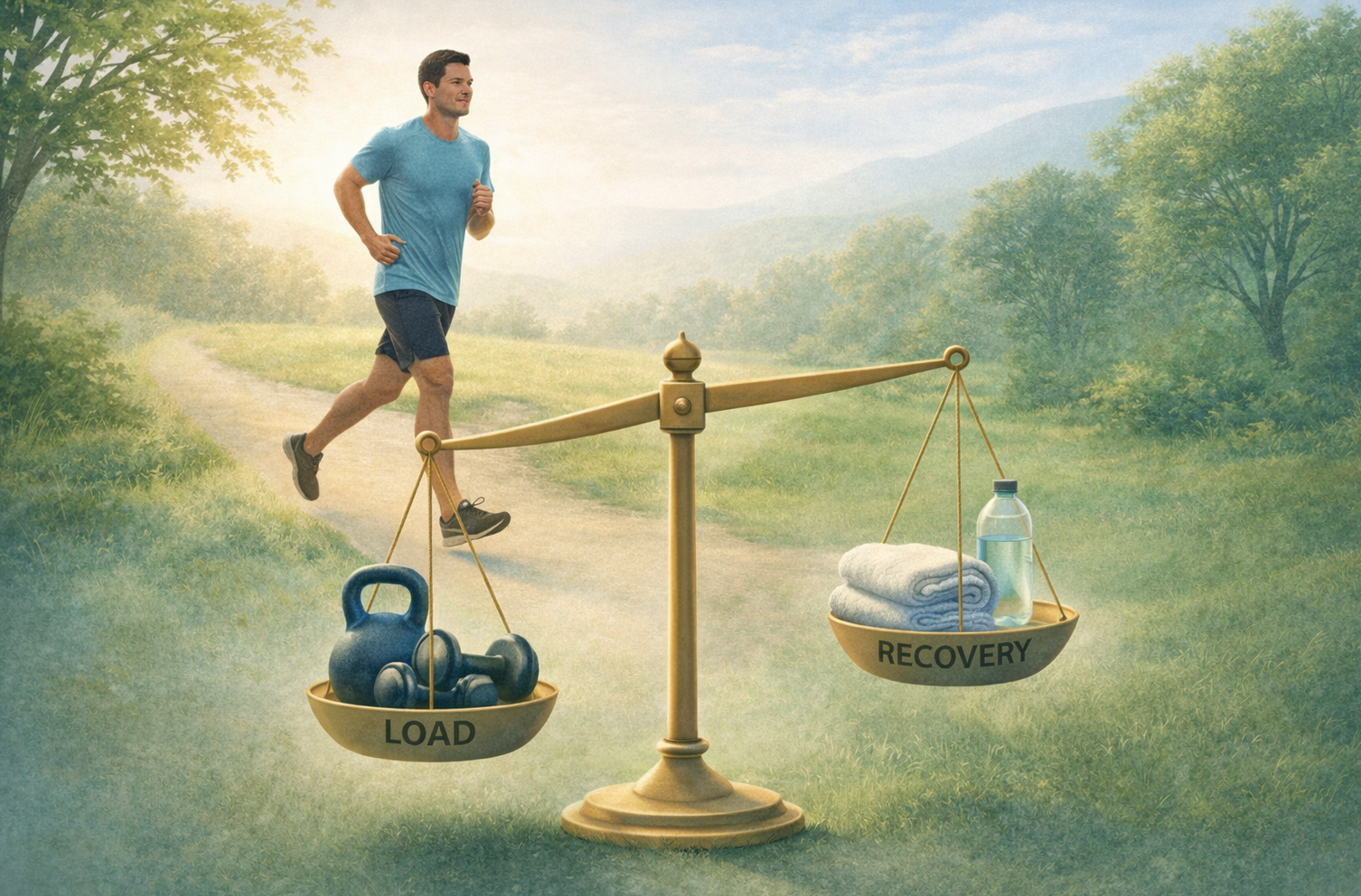
Capability = CAPACITY minus DEMANDS

Always keep this picture in mind!

Always keep this picture in mind!

What’s Your Current Physical Capacity Relative to the Demands?

Some research would suggest around 80% of injuries are due to ‘too much too soon’ where the demand is far greater than your current capacity.

You may need to more gradually stress your tissues and allow time for adaptation to occur.

“Long term consistency trumps short term intensity” - Bruce Lee

For more detailed info on load management please see here.

“Always be building your capacity”

In life we know there will always be times when you will be getting sick, under extreme stress (or fighting the threat of a global pandemic).

So when things are relatively calm and stable, it is worth investing time and energy into building your physical and mental capacity so you are able to effectively deal with the challenges that will come your way.


Equanimous

Equanimity = calmness and composure especially in a difficult situation

This is probably the hardest one to master.

Could you re-conceptualize an injury from a problem to be avoided to an opportunity to learn more about your body and become more robust and resilient?

index.jpg

Equanimity is a revered emotion and an attitude that is cultivated by a number of major religions and ancient philosophies.

Treat success and injuries the same.

Develop a growth mindset.

Injury isn’t always a bad thing - story of the horse who ran away - bad luck vs good luck - it doesn’t actually exist.

Everything happens for a reason.

Ultimately injuries provide us an opportunity to learn more about our bodies and grow stronger and more resilient in the process.

Worrying about an injury is a low-vibrational state.

Figuring out what you can put your energy into will bring about a faster resolution of symptoms as well as taking your focus off any negative emotional states.

So next time you have an injury, please think RICE:

  • Resilient - the human body is an incredibly resilient self-healing machine

  • Intuitive - allow space and openness to listen to the wisdom of the body

  • Capable - what’s your current capacity relative to the demands of your sport and life?

  • Equanimous - calmness and composure in a difficult situation

If you have found this useful, I’d love you to let me know by leaving a comment below.

Free Pain Guide

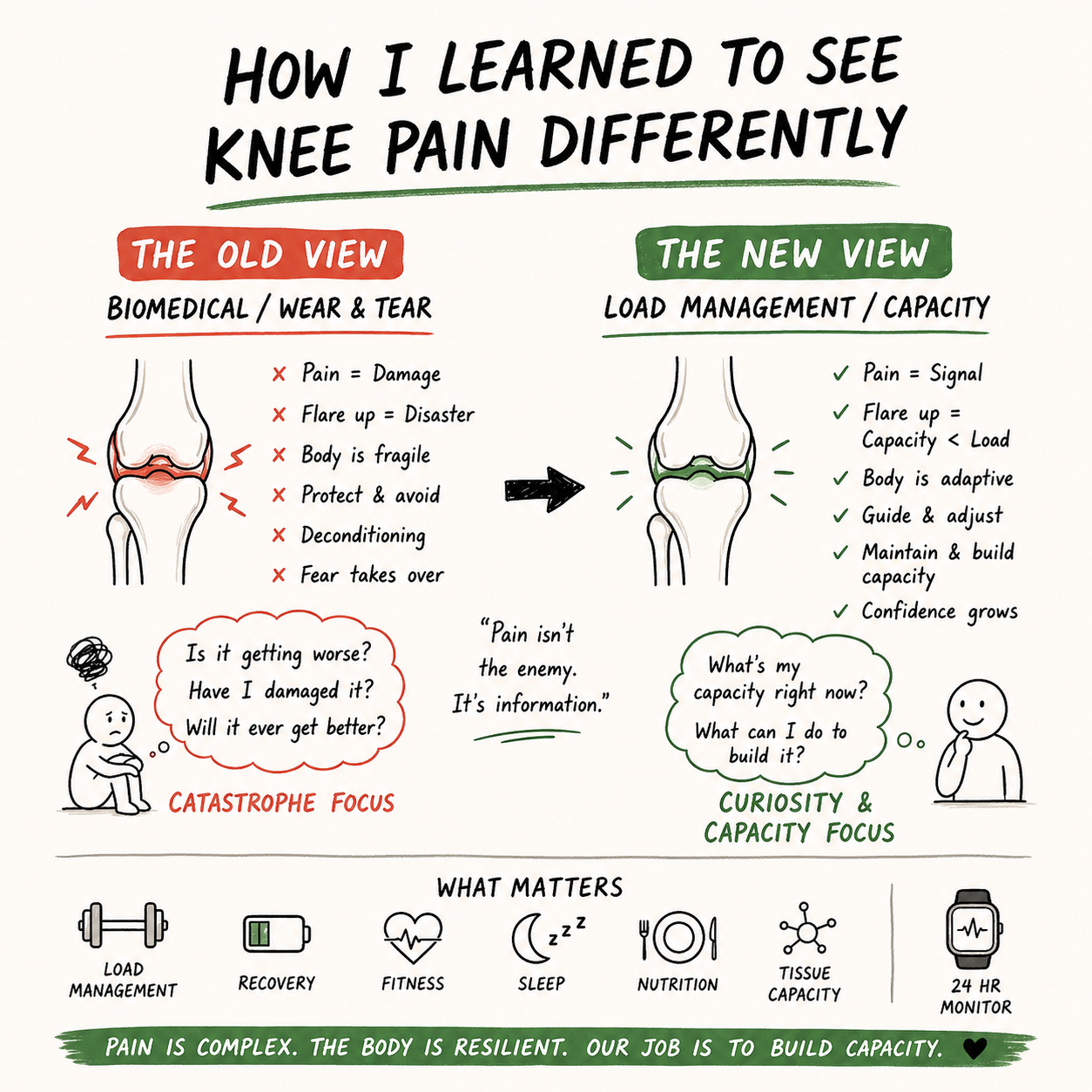
If you’re feeling ongoing pain and have ruled out serious red flags with your doctor (such as infection, inflammatory arthritis, fracture, cancer e.t.c) then it’s important that your pain makes sense to you.

Research has shown the when you understand more about your pain, then you become less threatened by the experience and get back to focusing on enjoying a happy and productive life.

This 71 page PDF, (available for free download) is a comprehensive and easy to understand pain education resource, written by Canadian Physiotherapist, Chiropractor and pain science researcher Greg Lehman.

You can download the BOOK HERE

Greg Lehman is a physiotherapist, chiropractor, middling researcher and continuing education educator (Reconciling biomechanics with pain science). Greg’s career in health care started with a MSc in Spine Biomechanics where he researched the mechanisms of manual therapy and exercise biomechanics.

Fortunately, Greg was introduced to the biopsychosocial model of pain and injury at this time as well as some excellent clinician researchers who challenged and researched many of the dogmas of our professions.

In clinical practice Greg recognises that the biopsychosocial model is of importance in all conditions and believes in treating with as wide a net as possible to address a multitude of factors. Here is his website


3 reasons sleep is every athlete's best friend

Sleep is crucial to everyone who wants to be the best that they can be.

It is all the more important for athletes who need to be at their physical peak in order to perform at their very best. It can be tempting when you are training hard for an all-important competition to forgo your sleep in favour of extra training, but you really are not doing yourself any favours.

Read on to find out exactly why sleep is your best friend and why you should make it a priority, even if you are training hard.

1. It can help you make healthier dietary choices

When it comes to training, one of the most important factors is diet.

It is no good training hard to get your body into peak condition and then filling it with the wrong types of foods. When we don’t get enough sleep we can create an imbalance in the hormones that tell us when to eat and when to stop.

Ultimately, a lack of sleep can lead to surplus ghrelin, the hormone that tells you it’s time to eat and a reduction in leptin, the hormone that tells you that you are full. It’s easy to see therefore, how lack of sleep can lead to overeating.

Add to this the fact that not getting enough sleep makes you feel rubbish anyway, making it more difficult to make good dietary choices, and you can see how you might not be in a position to fuel your body in the best way.

2. Repair muscles quicker

Studies show that sleep releases a growth hormone that is responsible for helping to repair muscle damage. It also plays a part in building new muscle, burning fat and strengthening bones. These are all essential if you are to make sure that your body is in peak condition ready to compete in a big event. It is recommended that athletes aim to get around two hours of extra sleep per night, for this very reason.

To ensure you get this extra rest, you might need to consider setting up a sleep routine for yourself, to help you maximise the amount of sleep that you get. It’s all about creating the right atmosphere, to tell your body it is time for sleep.

Look at your routine, how comfortable your bed is and also the temperature in your room. The ideal temperature is around 16-23C (60-75F), so take a look at your thermostat and see if turning it down might help you.

3. It can boost performance

Sleep deprivation affects glycogen and glucose production.

The body relies on these two substances to fuel itself and if you are not producing enough, it might be missing out on that extra fuel that it needs to get you through those difficult training sessions.

Not having enough glycogen and glucose in the system can also impair cognitive functioning, which could be detrimental when it comes to making sure you are on top of your game ready for the big event too.

Much success in sport comes from brain power and being able to logically work out your way to the top.

Don’t harm your chances by cutting back on your sleep.


Chronic Pain - The Myths

Chronic pain is a significant global health burden and low back pain causes more disability than any other condition.

Interpreting pain

People with negative beliefs about their pain report higher levels of pain intensity and disability.

People with musculoskeletal pain often view their body as being a fragile or a vulnerable structure which is easy to (re)injure.

Here are some common misconceptions about pain:

Screen Shot 2019-09-02 at 9.17.59 am.png
Credit: World Confederation of Physical Therapy

Credit: World Confederation of Physical Therapy

Some facts about pain

Acute pain alarms us about potential tissue damage and typically comes on suddenly as a result of a specific incident.

Chronic pain serves no biologic purpose as it is not related to actual tissue damage, but more the threat of tissue damage.

Sensitive Alarms

To understand chronic pain more simply, think of a house with a security alarm set up.

After the house was burgled a few months ago, the owners decided to set the alarm’s sensitivity to high.

So every time the wind blew, it would blow a lot of leaves and debris around - setting off the alarm system. The owners woke up to the alarm and prepared for a ‘fight-flight’ situation. But each time the alarm went off, they didn’t find anything wrong.

After an injury, the body is biologically wired to act like a sensitive alarm system - magnifying small normal niggles.

This is a normal and healthy protective response.

For some people though, while the original injury can heal (normally taking no longer than 3-6 months), this protective response (highly sensitive alarm system) can remain in place indefinitely.

This can lead to overwhelming sense of anxiety and fear, that can turn into a downward spiral of inactivity, de-conditioning and eventually more pain.

Maybe the most important picture to understand if you’ve had pain lasting more than six months.Pain that lasts more than six months is generally related to an overly sensitive nervous system rather than a specific issue in the tissues(Picture credit…

Maybe the most important picture to understand if you’ve had pain lasting more than six months.

Pain that lasts more than six months is generally related to an overly sensitive nervous system rather than a specific issue in the tissues

(Picture credit: Explain Pain - Butler & Mosely)

Consulting with a Physio who is specialised to treat chronic pain can help you discover if you have a sensitive nervous system and get you back on the fast track to living life again.

Physiotherapists will help you understand how chronic pain works.

They will help you reduce the fear attached to pain and explore long-term strategies to build confidence through engaging in activities that you once enjoyed.

Exercise and building capacity

People who have suffered chronic pain often have reduced physical capacity, that has dropped over a period of months or years.

This keeps them in the ‘zone of stress’ where everyday tasks can seem over-whelming and tiring.

The only way to get on top long term is to re-build your capacity, to create zone of relaxation, where you can easily handle the demands of everyday life.

image-asset.jpeg

A few tips:

  1. Increase training or exercise loads gradually – our bodies don’t like surprises

  2. Avoid changing too many training or exercise factors in one go

  3. Participate in a program that focuses on whole body strength to ensure the body is tolerant to changes in exercise load

  4. Pace yourself. Break bigger activities into smaller chunks.

Screen Shot 2019-09-02 at 9.27.46 am.png

Pain is normal - use this scale to guide your level of activity

Some people with chronic pain become overly sensitive at perceiving small normal niggles.

When you start to resume your activities., pain that is at a 0-5 level is considered ACCEPTABLE —> KEEP GOING.

Pain that increases to 5-10 means you are probably over-doing it and need to rest or modify your activity.

Pay attention to your pain during the activity as well as notice the 24 hour response e.g. the next day.

Screen Shot 2019-09-02 at 4.55.38 pm.png

Need some help with getting you back to doing what you love?

If you think we are the right fit for you and you wish to get relief right away, use our simple online booking system to make an appointment.  If you would prefer to speak to us directly,  call us 1300 657 813


Pain on Inside of Knee? Get To Know Your VMO

The Resilient Knee Project is an innovative solution for people with chronic knee pain that empowers individuals to self-manage their pain and most importantly, get them back to enjoy the physical and mental benefits of running.

Founded by Daniel O’Grady, dedicated professional with first hand experience of overcoming knee pain and running the NYC Marathon, the project aims to be a world leader in restoring people’s confidence in their knees and get back to doing what they love.

Is The Resilient Knee Program right for you?

Take the free quiz here

Get to your know your VMO

static1.squarespace.com.jpg

If you’ve ever had a nagging pain on the inside of your knee or a knee that seems to buckle or give way, there is a fair chance you’ve had some dysfunction in the VMO muscle.

VMO dysfunction is very common in runners, hikers, cyclists, athletes involved in jumping sports and after any knee injury.

In this short blog, we’ll find out more about how issues develop in the VMO and what you can do to help.

WHAT IS THE VMO MUSCLE?

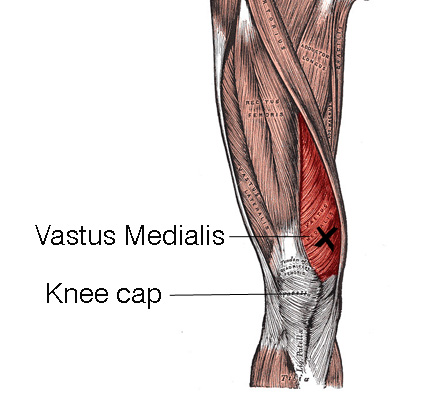
VMO stands for Vastus Medialis Oblique and this is part of the quads, running along the inside of the thigh, with the bulk of the muscle sitting directly above the inside of the knee.

blog-vastus-med.jpg

FUNCTION:

The role of the VMO is to assist with extending your knee and arguably the most responsible muscle for knee stability, as it helps control the alignment of the knee-cap.

When the VMO isn’t functionally optimally, the knee cap tends to shift slightly out of place during movements such as squats and lunges, causing pain and inflammation behind the knee-cap.

SYMPTOMS:

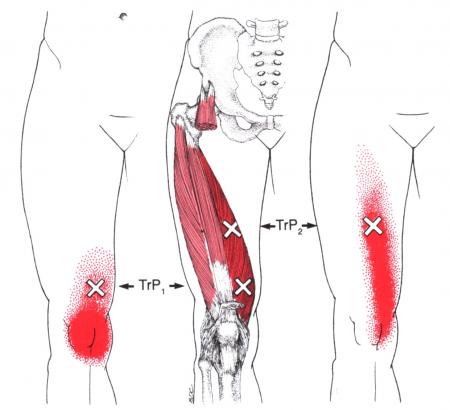
When the quads get overloaded (suddenly or over time), tightness in the muscle fibres (called trigger points) can refer a toothache-like pain deep in the knee joint (see Figure 1 below).

This pain from the overloaded VMO muscle can often be confused with joint pain such osteo-arthritis or a meniscus tear, as the location and type of pain are often similar.

Figure 1

Figure 1

The initial knee pain then may disappear after a few weeks, only to be replaced by a sudden weakness in the knee (a condition called “buckling knee”) that causes a person to unexpectedly fall while walking.

HOW THE VMO BECOMES OVERLOADED:

The VMO can be activated as a protective response to knee injury such as to the ligaments, meniscus or post-surgery.

The VMO is also commonly overloaded with repeated use in the following situations:

  • suddenly increasing your volume of running or cycling (running places around 6 x body weight through the quads)

  • a new (or sudden increase) in an exercise program involving repetitive squats, lunges, leg extensions or wall sits

  • jumping sports e.g. basketball

  • cycling - poor bike fit

  • walking downhill or stairs

  • being over-zealous in rehabbing the VMO - too much strengthening too soon

TREATMENT:

Physiotherapy assessment will involve a comprehensive movement assessment to determine the cause of your VMO issue.

“Short term treatment such as soft tissue massage and dry needling is very helpful, while long term building capacity in the quads, glutes and core is critical to prevent a relapse.


TRIGGER POINT DRY NEEDLING:

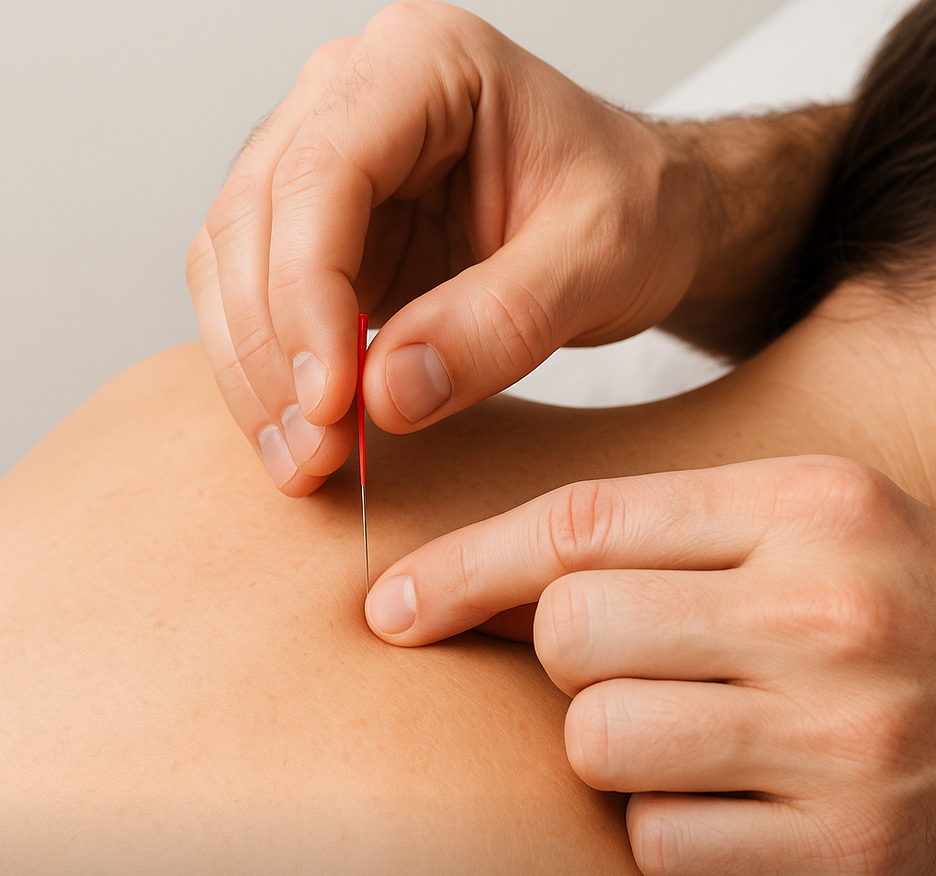
Tightness and contraction of the VMO responds very well to dry needling, which can de-activate the trigger points (knots in the muscle).

The benefit of dry needling is that it can reach the deep fibers of the muscle and lead to a quicker resolution of symptoms. 

Treatment of the VMO is generally very responsive to treatment, provided the contributing factors are addressed.

SELF-CARE TIPS:

  • apply heat to the VMO muscle 10 minutes each day to increase blood flow and reduce tension

  • if you’re a runner or hiker, avoid the hills (in the short-term)

  • ensure your shoes are not overly worn

  • when running - avoid over-striding, ensure proper warm up and cool down and take walking breaks frequently to avoid overloading the VMO

  • avoid prolonged kneeling on the floor e.g. gardening, washing floors - use a low bench or stool to sit on instead

  • foam roll the VMO daily for a few minutes (see below). It’s also a good idea to roll out the adductors which are also commonly tight

Foam Roller for the VMO:

Foam rolling the inner quad and adductor - fun times!

Foam rolling the inner quad and adductor - fun times!

Let’s get you back to doing what you love…

If you’d like to get your knee on the fast track straight away, please use the button below to schedule an appointment:

_MG_0480.JPG

Dan O'Grady is a results driven qualified Physiotherapist and member of the Australian Physiotherapy Association.  Dan has a special interest in treating knee pain.  He has been working in private practice for 15 years. He is passionate about helping people to move better, feel better and get back to doing what they love.


Download the The Healthy Knees E-Book - now on special !!